
350-501 · Question #579
Refer to the exhibit. The four PEs are members of AS 65514 The service provider network provides internet services through a connection on PE3. The company ABC location at CE1 is its first site to…
The correct answer is A. Configure PE2 with a route target import of 103:103 for the VRF that services CE1. To enable internet services for Company ABC (CE1) via its connected VRF, PE2 must be configured to import the specific route target (103:103) that PE3, the internet gateway, uses to export internet routes.
Question
Refer to the exhibit. The four PEs are members of AS 65514 The service provider network provides internet services through a connection on PE3. The company ABC location at CE1 is its first site to connect to the service provider network. Which action must an engineer at the service provider take so that company ABC receives internet services via CE1 ?
Exhibit
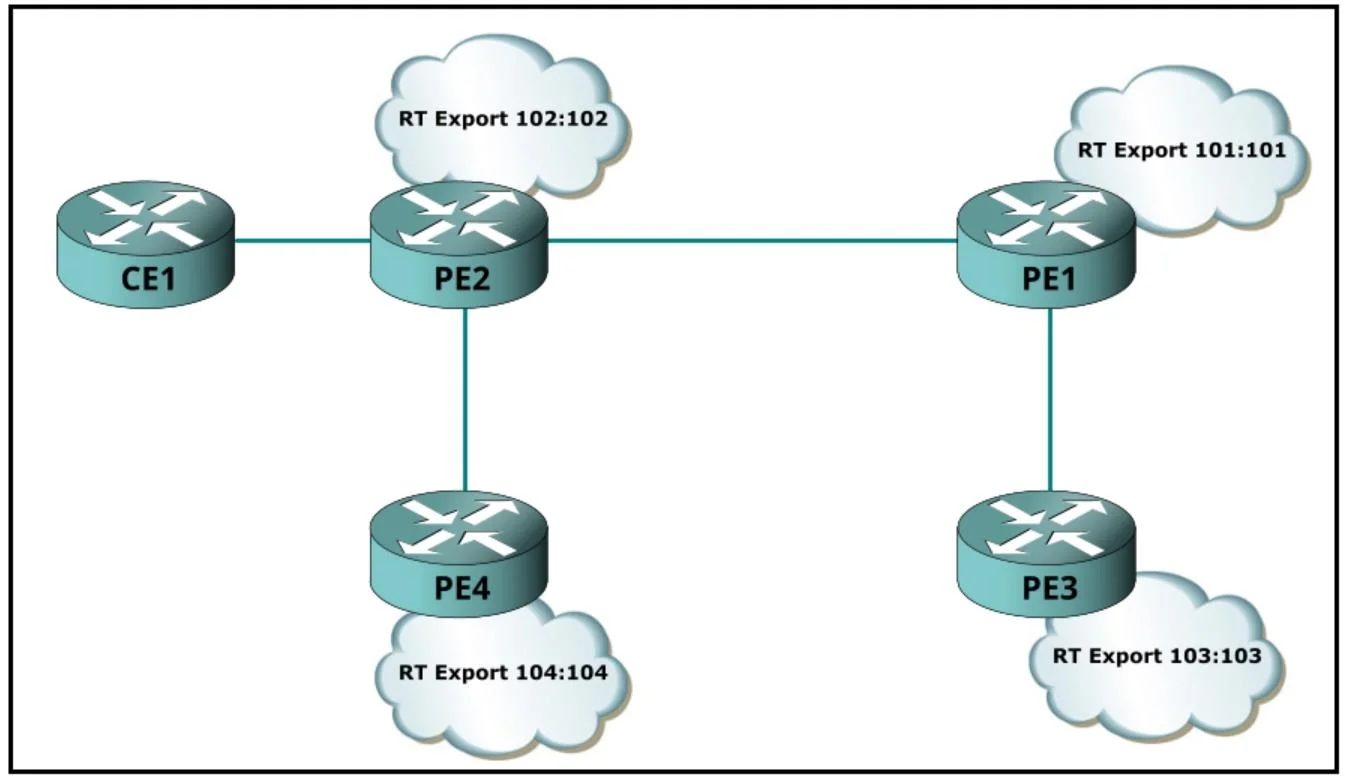
Options
- AConfigure PE2 with a route target import of 103:103 for the VRF that services CE1
- BConfigure a connection between PE3 and PE4 to exchange VPNv4 roules.
- CConfigure PE1, PE2. and PE4 as route reflector clients of PE3 so that internet routes can be
- DConfigure PE1 and PE2 with the same value for their route distinguisher.
How the community answered
(43 responses)- A84% (36)
- B9% (4)
- C5% (2)
- D2% (1)
Why each option
To enable internet services for Company ABC (CE1) via its connected VRF, PE2 must be configured to import the specific route target (103:103) that PE3, the internet gateway, uses to export internet routes.
For CE1's VRF to receive internet routes from PE3, PE3 must export those routes with a specific route target (e.g., 103:103). The VRF on PE2, which is presumably part of the VPN path or designated for internet route distribution for CE1's VPN, must then be configured to import this route target to make the internet routes available.
Configuring a direct VPNv4 route exchange between PE3 and PE4 does not directly enable CE1 (connected to PE1) to receive internet services, as it doesn't specify route target import for CE1's VRF.
Configuring PE1, PE2, and PE4 as route reflector clients of PE3 facilitates BGP VPNv4 route propagation within the AS but does not, by itself, import specific internet routes into a customer VRF.
Route distinguishers (RDs) are used to make VPN prefixes unique within BGP, but they do not control the import or export of routes between VRFs or the global table; route targets (RTs) serve this function.
Concept tested: MPLS VPN route target import for internet
Source: https://www.cisco.com/c/en/us/support/docs/ip/border-gateway-protocol-bgp/200704-BGP-Based-MPLS-VPN-Internet-Access-Scenar.html
Topics
Community Discussion
No community discussion yet for this question.