
350-501 · Question #566
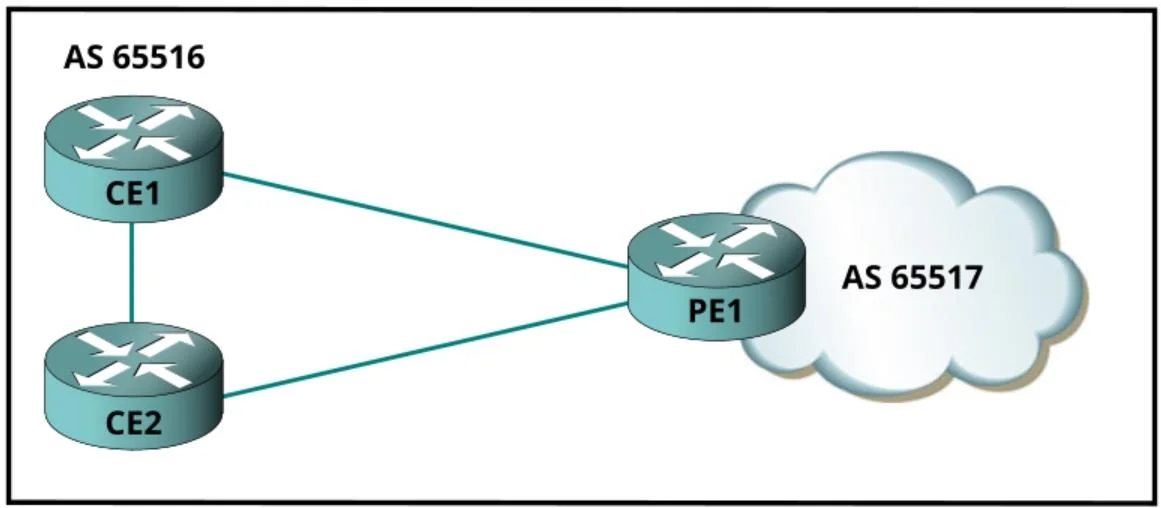
Refer to the exhibit. CE1 and CE2 reside in AS 65516 and access the internet through PE1, which resides in AS 65517. The PE-CE routing protocol is BGP and CE1 and CE2 have an established iBGP…
The correct answer is A. Apply a route map on CE1 in the outbound direction to PE1 that sets the MED to a lower value. To make CE1 the preferred entry point for traffic from PE1, CE1 must influence PE1's inbound routing decision by applying an outbound route map towards PE1 that sets a lower BGP Multi-Exit Discriminator (MED) value.
Question
Refer to the exhibit. CE1 and CE2 reside in AS 65516 and access the internet through PE1, which resides in AS 65517. The PE-CE routing protocol is BGP and CE1 and CE2 have an established iBGP peering. A network engineer must implement a route map on CE1 so that it becomes the preferred Entry Point for traffic from PE1. Which action must the engineer take to meet the requirement?
Exhibit
Options
- AApply a route map on CE1 in the outbound direction to PE1 that sets the MED to a lower value
- BApply a route map on CE1 in the inbound direction from PE1 that sets the weight to a value
- CApply a route map on CE1 in the outbound direction to PE1 that prepends AS 65516 twice to the
- DApply a route map on CE1 in the inbound direction from PE1 that sets the local preference to a
How the community answered
(37 responses)- A78% (29)
- B5% (2)
- C14% (5)
- D3% (1)
Why each option
To make CE1 the preferred entry point for traffic from PE1, CE1 must influence PE1's inbound routing decision by applying an outbound route map towards PE1 that sets a lower BGP Multi-Exit Discriminator (MED) value.
The Multi-Exit Discriminator (MED) BGP attribute is used to influence the path selection of an external AS (PE1 in AS 65517) when receiving routes from multiple entry points within an adjacent AS (CE1 and CE2 in AS 65516). By applying an outbound route map on CE1 towards PE1 that sets a lower MED value, CE1 tells PE1 that it is the more preferred path into AS 65516, thus making CE1 the preferred entry point for traffic coming from PE1.
Weight is a Cisco-proprietary BGP attribute that is local to the router and influences its own outbound path selection; it cannot influence a remote router's (PE1's) inbound path decision.
AS-path prepending is used to make a path less desirable by artificially lengthening the AS-path attribute, which is the opposite of making CE1 the preferred entry point.
Local Preference is a BGP attribute used to influence outbound path selection within an AS, not how a remote AS (PE1) chooses to send traffic into the local AS (65516).
Concept tested: BGP path attributes for inbound traffic engineering (MED)
Source: https://www.cisco.com/c/en/us/support/docs/ip/border-gateway-protocol-bgp/13761-40.html
Topics
Community Discussion
No community discussion yet for this question.