
350-501 · Question #468
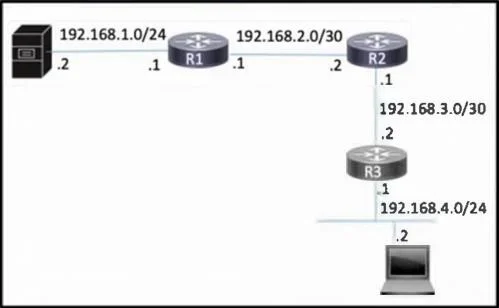
Refer to the exhibit. A company uses PIM-SM multicast with IGMPv2 to stream training videos from a server in network 192.168.1.2/24 to hosts that reside in 192.168.4.0/24. The company is…
The correct answer is D. Implement IGMPv3 on all routers. Source-Specific Multicast (SSM) improves multicast efficiency by allowing hosts to specify both the multicast group and the source from which they want to receive traffic. IGMPv3 is required for SSM because it supports source filtering, enabling hosts to dynamically register to…
Question
Refer to the exhibit. A company uses PIM-SM multicast with IGMPv2 to stream training videos from a server in network 192.168.1.2/24 to hosts that reside in 192.168.4.0/24. The company is implementing SSM to improve efficiency within Layer 2. Which task should the engineer perform to allow hosts to dynamically register to a multicast group when reaching the server at 192.168.1.2?
Exhibit
Options
- AConfigure bidirectional PIM on R2
- BConfigure an IGMP querier on R3
- CImplement PIM-DM on the interface between R2 and R3
- DImplement IGMPv3 on all routers
How the community answered
(55 responses)- A2% (1)
- B7% (4)
- C4% (2)
- D87% (48)
Explanation
Source-Specific Multicast (SSM) improves multicast efficiency by allowing hosts to specify both the multicast group and the source from which they want to receive traffic. IGMPv3 is required for SSM because it supports source filtering, enabling hosts to dynamically register to a specific multicast group and source. In this scenario, enabling IGMPv3 on all routers ensures that the multicast traffic from the server at 192.168.1.2 can be delivered efficiently to the host network
Topics
Community Discussion
No community discussion yet for this question.