
350-501 · Question #421
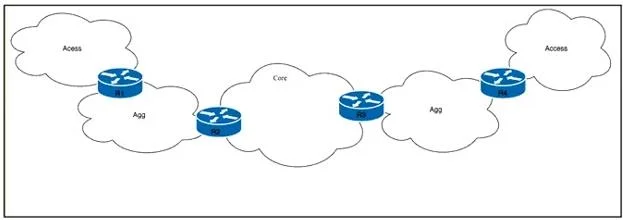
Refer to the exhibit. Tier 1 ISP A purchased several Tier 2 ISPs to increase their customer base and provide more regional coverage. ISP A plans to implement MPLS services in the access layer, with…
The correct answer is A. Implement BGP inline RR functionality with next-hop-self capabilities on routers R2 and R3. E. Implement BGP PIC core functionality on routers R2 and R3. To meet the scalability and fast recovery requirements for MPLS services with independent IGP/LDP domains and RFC 3107 LSP interconnection, implementing BGP Route Reflectors with next-hop-self and BGP PIC core functionality is necessary.
Question
Refer to the exhibit. Tier 1 ISP A purchased several Tier 2 ISPs to increase their customer base and provide more regional coverage. ISP A plans to implement MPLS services in the access layer, with scalability up to 100,000 devices in one packet network and service recovery up to 50 ms. The network architect decided to use different independent IGP and LDP domains and interconnect LSPs that are based on RFC 3107. Which two actions must the network engineer perform to meet the requirements? (Choose two.)
Exhibit
Options
- AImplement BGP inline RR functionality with next-hop-self capabilities on routers R2 and R3.
- BImplement the IS-IS routing protocol on the access domain.
- CImplement BGP connectivity between routers R1 and R4 with VPNv4 address family enabled.
- DConfigure three OSPF areas, with Area 0 in the core domain, and Areas 2 and 3 in the
- EImplement BGP PIC core functionality on routers R2 and R3.
How the community answered
(36 responses)- A61% (22)
- B22% (8)
- C11% (4)
- D6% (2)
Why each option
To meet the scalability and fast recovery requirements for MPLS services with independent IGP/LDP domains and RFC 3107 LSP interconnection, implementing BGP Route Reflectors with next-hop-self and BGP PIC core functionality is necessary.
Implementing BGP Route Reflectors (RR) on R2 and R3 enhances scalability for 100,000 devices by reducing the number of BGP peerings, while next-hop-self ensures correct reachability when BGP distributes labeled routes per RFC 3107.
Implementing IS-IS in the access domain is an IGP choice but does not directly address the BGP-based LSP interconnection (RFC 3107), scalability, or rapid recovery requirements mentioned.
Configuring BGP VPNv4 between R1 and R4 addresses MPLS L3VPN services (RFC 4364), but the question specifies RFC 3107-based LSP interconnection and focuses on network core scalability and recovery, not VPN service deployment details.
Configuring OSPF multi-area is an IGP design choice that does not specifically address the BGP-based LSP interconnection, scalability, or rapid recovery requirements for the core network.
BGP Prefix-Independent Convergence (PIC) core functionality on R2 and R3 directly addresses the stringent 50 ms service recovery requirement by pre-computing backup paths, allowing for rapid rerouting upon primary path failures.
Concept tested: BGP scalability and fast convergence in MPLS
Source: https://www.cisco.com/c/en/us/td/docs/ios-xml/ios/iproute_bgp/configuration/xe-16-9/bgp-xe-16-9-book/bgp-prefix-independent-convergence.html
Topics
Community Discussion
No community discussion yet for this question.