
350-501 · Question #411
Refer to the exhibit. Over the last few months, ISP A has doubled its user base. The IT Director asked the engineering team to monitor memory consumption and buffer statistics on all P and PE…
The correct answer is A. snmp-server enable traps memory bufferpeak B. snmp-server host 192.168.101.1 version 1 community1 auth memory. To monitor memory and buffer statistics using SNMP traps securely, enable specific memory bufferpeak traps and configure the SNMP host to receive only memory-related traps using a community string.
Question
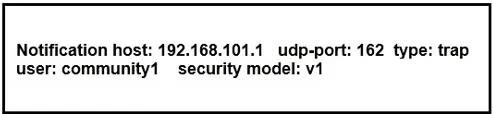
Refer to the exhibit. Over the last few months, ISP A has doubled its user base. The IT Director asked the engineering team to monitor memory consumption and buffer statistics on all P and PE devices in the MPLS core. Most devices have CPU usage of 70% or more, so the solution must be targeted and secure. Which two commands must the engineering team implement on P and PE devices to meet these requirements? (Choose two.)
Exhibit
Options
- Asnmp-server enable traps memory bufferpeak
- Bsnmp-server host 192.168.101.1 version 1 community1 auth memory
- Csnmp-server enable snmp-traps community1 bufferpeak
- Dsnmp-server host 192.168.101.1 version 2c community1 memory
- Esnmp-server host 192.168.101.1 version 3 auth community1 memory
How the community answered
(37 responses)- A76% (28)
- C3% (1)
- D16% (6)
- E5% (2)
Why each option
To monitor memory and buffer statistics using SNMP traps securely, enable specific memory bufferpeak traps and configure the SNMP host to receive only memory-related traps using a community string.
The snmp-server enable traps memory bufferpeak command explicitly activates the generation of SNMP traps when memory buffer peaks occur, directly addressing the requirement to monitor memory consumption and buffer statistics. This makes the solution targeted.
The snmp-server host 192.168.101.1 version 1 community1 auth memory command specifies the destination for SNMP traps (the NMS at 192.168.101.1), designates the use of SNMPv1 with 'community1' for basic authentication, and critically, the memory keyword at the end directs the router to send only memory-related traps, ensuring the solution is targeted as required.
The snmp-server enable snmp-traps community1 bufferpeak command has incorrect syntax; snmp-server enable traps is the correct form, and community1 is part of the host configuration, not trap enabling.
While snmp-server host 192.168.101.1 version 2c community1 memory specifies a host and community, SNMPv2c is not considered secure in the context of 'targeted and secure' requirements compared to SNMPv3, and the question uses version 1 for the correct answer.
snmp-server host 192.168.101.1 version 3 auth community1 memory would be the most secure option for SNMP trap forwarding due to authentication mechanisms in SNMPv3, but it is not one of the provided correct answers.
Concept tested: SNMP trap configuration for resource monitoring
Source: https://www.cisco.com/c/en/us/td/docs/ios/netmgmt/configuration/guide/nm_snmp_cfg.html
Topics
Community Discussion
No community discussion yet for this question.