
350-501 · Question #410
Refer to the exhibit. A host connected to R3 must connect with a server on R1 that provides critical, time-sensitive data. Traffic between the host and server must always be given bandwidth to…
The correct answer is C. Implement strict priority to guarantee bandwidth for the server traffic. To ensure critical, time-sensitive data always receives bandwidth and takes precedence during congestion, a strict priority queuing mechanism should be implemented.
Question
Refer to the exhibit. A host connected to R3 must connect with a server on R1 that provides critical, time-sensitive data. Traffic between the host and server must always be given bandwidth to traverse the links when they are congested, with other traffic being dropped. How must the network engineer implement a QoS strategy with classification to ensure that the traffic is given the appropriate bandwidth?
Exhibit
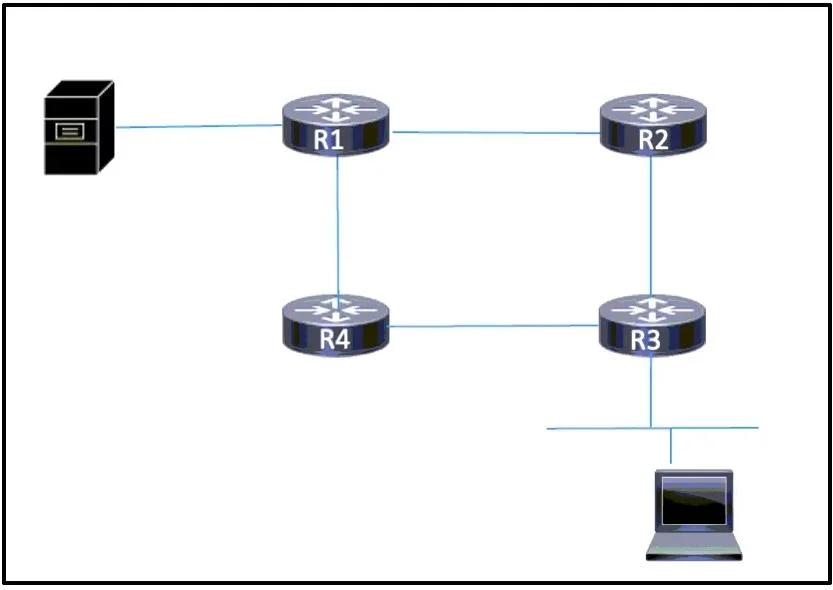
Options
- AImplement policing to rate-limit noncritical traffic that exceeds designated thresholds.
- BImplement traffic shaping to delay noncritical traffic when the link is congested.
- CImplement strict priority to guarantee bandwidth for the server traffic.
- DImplement FIFO to guarantee that the server traffic is sent first while other traffic is queued.
How the community answered
(50 responses)- A4% (2)
- B12% (6)
- C80% (40)
- D4% (2)
Why each option
To ensure critical, time-sensitive data always receives bandwidth and takes precedence during congestion, a strict priority queuing mechanism should be implemented.
Policing rate-limits traffic by dropping packets that exceed a specified threshold, which controls overall traffic but does not guarantee priority or bandwidth to specific critical traffic over other traffic.
Traffic shaping buffers and delays traffic that exceeds a specified rate, smoothing out bursts but not providing strict preferential forwarding for critical traffic over other congested traffic.
Implementing strict priority ensures that the critical server traffic is placed in a dedicated high-priority queue and is transmitted before any other traffic, as long as there is data in that queue. This guarantees that the critical traffic receives its required bandwidth even during congestion, aligning with the requirement for it to always be given bandwidth while other traffic may be dropped.
FIFO (First-In, First-Out) queuing processes packets in the order they arrive, providing no preferential treatment or guaranteed bandwidth for critical server traffic over other traffic.
Concept tested: QoS queuing mechanisms- strict priority
Source: https://www.cisco.com/c/en/us/td/docs/ios/qos/configuration/guide/qos_cbook/qos_q.html#wp1010317
Topics
Community Discussion
No community discussion yet for this question.