
350-501 · Question #405
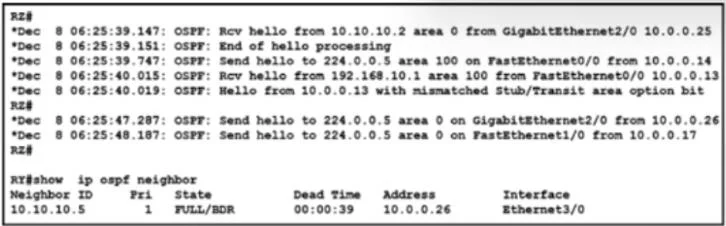
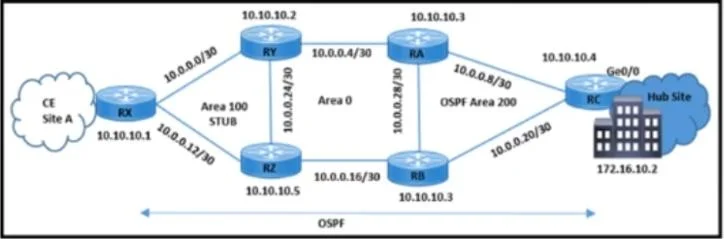
Refer to the exhibit. A network engineer received a complaint about these problems in OSPF stub area 100: - The Ethernet link is down between routers RX and RY because the fiber was cut. - CE site A…
The correct answer is A. Change the OSPF area 100 type to stub on RZ. In an OSPF stub area, all routers in the area, including the ABR, must agree on the stub area configuration to ensure proper routing, especially the injection of a default route for external reachability. If CE site A's traffic is being dropped while trying to reach the hub…
Question
Refer to the exhibit. A network engineer received a complaint about these problems in OSPF stub area 100:
- The Ethernet link is down between routers RX and RY because the fiber
was cut.
- CE site A traffic to the hub site is being dropped.
Which action resolves these issues?
Exhibits
Options
- AChange the OSPF area 100 type to stub on RZ.
- BSet the OSPF MTU to 1500 on the link between RX and RZ.
- CSet the OSPF authentication type to MD5 between RX and RY.
- DChange the OSPF priority to 100 on the Interfaces that connect RX and RY.
How the community answered
(50 responses)- A84% (42)
- B4% (2)
- C8% (4)
- D4% (2)
Why each option
In an OSPF stub area, all routers in the area, including the ABR, must agree on the stub area configuration to ensure proper routing, especially the injection of a default route for external reachability. If CE site A's traffic is being dropped while trying to reach the hub site from stub Area 100, it suggests a routing issue where the ABR (RZ) is not correctly injecting the default route, which is resolved by configuring RZ as a stub for Area 100.
In an OSPF stub area, all routers within that area, including any attached ABRs, must be configured as stub to ensure correct operation and route propagation. If RZ is the ABR for OSPF stub Area 100 and is not configured as stub, it will not inject a default route into the area, preventing devices like CE site A from reaching destinations outside the area (like the hub site), causing traffic to be dropped.
Setting MTU on the link between RX and RZ would address a peering issue on that specific link, but the problem states the RX-RY link is down and implies a routing issue for CE site A's traffic to the hub, which is external to the stub area.
Changing authentication type on the RX-RY link is irrelevant since the fiber is cut, meaning the link is physically down.
OSPF priority affects DR/BDR election on multi-access segments, and changing it on a physically down link between RX and RY would not resolve the traffic drop issue for CE site A from the stub area.
Concept tested: OSPF Stub Area configuration on ABR
Source: https://www.cisco.com/c/en/us/td/docs/ios-xml/ios/iproute_ospf/configuration/xe-3s/iro-xe-3s-book/iro-cfg-ospfv2.html
Topics
Community Discussion
No community discussion yet for this question.