
350-501 · Question #403
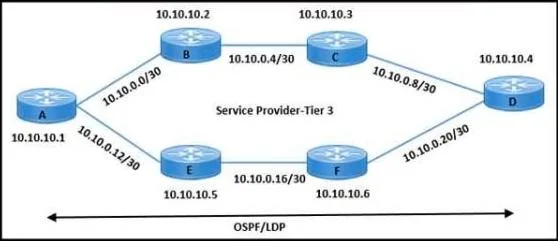
Refer to the exhibit. An engineering team must update the network configuration so that data traffic from router A to router D continues in case of a network outage between routers B and C. During a…
The correct answer is D. Enable MPLS LDP IGP Synchronization on all routers. When a network outage causes the IGP to switch traffic to an alternate path, but label forwarding fails on this new path, it indicates a desynchronization between IGP and LDP. Enabling MPLS LDP IGP Synchronization on all routers ensures that the IGP waits for LDP to establish…
Question
Refer to the exhibit. An engineering team must update the network configuration so that data traffic from router A to router D continues in case of a network outage between routers B and C. During a recent outage on the B-C link, the IGP traffic path was switched to the alternate path via routers E and F, but label forwarding did not occur on the new path. Which action ensures that traffic on the end-to-end path continues?
Exhibit
Options
- AConfigure the same hello timer values for IGP and LDP
- BEnable LDP Session Protection on routers A and D
- CBind the BFD protocol with IGP on all routers
- DEnable MPLS LDP IGP Synchronization on all routers
How the community answered
(27 responses)- A7% (2)
- B4% (1)
- C15% (4)
- D74% (20)
Why each option
When a network outage causes the IGP to switch traffic to an alternate path, but label forwarding fails on this new path, it indicates a desynchronization between IGP and LDP. Enabling MPLS LDP IGP Synchronization on all routers ensures that the IGP waits for LDP to establish adjacencies and exchange labels on a link before advertising its reachability, thus preventing MPLS traffic from being dropped during IGP reconvergence.
While matching IGP and LDP hello timers can aid faster convergence, it does not guarantee that LDP will be ready on a new path precisely when the IGP switches to it.
LDP Session Protection is used to maintain existing LDP sessions and labels through control plane restarts or brief IGP adjacency flaps, not to ensure LDP readiness on newly converged IGP paths.
BFD accelerates link failure detection for IGPs, which can speed up IGP convergence, but it does not address the synchronization issue between IGP and LDP on a new path.
The symptom of IGP switching to an alternate path but label forwarding not occurring indicates that the IGP has converged faster than LDP on the new path, leading to traffic blackholing. Enabling MPLS LDP IGP Synchronization on all routers forces the IGP to delay advertising a link's reachability until LDP has fully established an adjacency and exchanged labels over that link, ensuring MPLS traffic can be forwarded immediately when the IGP selects the path.
Concept tested: MPLS LDP IGP Synchronization
Source: https://www.cisco.com/c/en/us/td/docs/ios-xml/ios/mpls/configuration/xe-3s/mp-xe-3s-book/mp-ldp-igp-sync.html
Topics
Community Discussion
No community discussion yet for this question.