
350-501 · Question #397
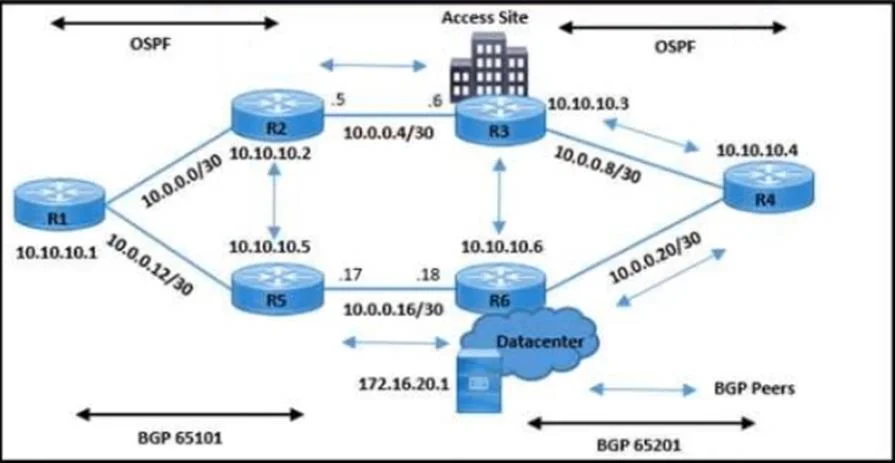
Refer to the exhibit. The network operations team reported that the access site that is connected to R3 is not connecting to the application server in the data center and that all packets that are…
The correct answer is C. Allow 172.16.20.1 in the BGP advertisement on R3 in the route-map. The access site cannot connect to the application server, and packets from the server to the access site are dropped. The most direct resolution for the access site not connecting is to ensure R3 has the route to the application server (172.16.20.1). This is achieved by…
Question
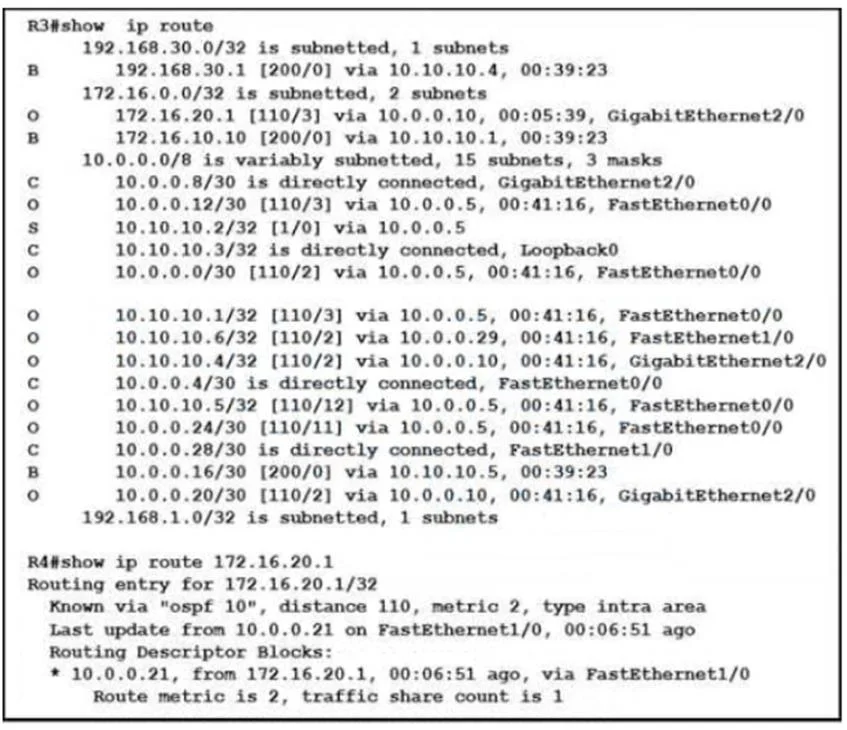
Refer to the exhibit. The network operations team reported that the access site that is connected to R3 is not connecting to the application server in the data center and that all packets that are sent from the application server to the access site are dropped. The team verified that OSPF and BGP peerings are up in BGP AS 65101 and BGP AS 65201. R4 is expected to receive traffic from the application server route via OSPF. Which action resolves this issue?
Exhibits
Options
- AAdvertise application server 172.16.20.1 in the OSPF routing table on R6
- BAdd the next-hop-self command on R6 to enable R3 iBGP peering
- CAllow 172.16.20.1 in the BGP advertisement on R3 in the route-map
- DRemove the route-map on R4 when advertising 172.16.20.1 in BGP to R3
How the community answered
(36 responses)- A3% (1)
- B6% (2)
- C83% (30)
- D8% (3)
Why each option
The access site cannot connect to the application server, and packets from the server to the access site are dropped. The most direct resolution for the access site not connecting is to ensure R3 has the route to the application server (172.16.20.1). This is achieved by adjusting an inbound BGP route-map on R3 to permit 172.16.20.1.
The question states "R4 is expected to receive traffic from the application server route via OSPF," implying R6 is already advertising 172.16.20.1 into OSPF. If R6 wasn't advertising, R4 wouldn't receive it, and R3 wouldn't learn it.
R3 and R6 are in different autonomous systems and do not directly peer via BGP, making `next-hop-self` on R6 irrelevant for R3's iBGP peering.
The issue of the access site not connecting to the application server suggests that R3 lacks a route to 172.16.20.1. If an inbound BGP route-map on R3 is currently filtering this route, modifying it to explicitly permit 172.16.20.1 will allow R3 to learn the application server's route from R4, enabling the access site to establish connectivity. This also addresses the lack of return traffic, as the server cannot reply to a connection that was never established or completed.
While removing a route-map on R4 might also allow 172.16.20.1 to be advertised to R3, choice C specifies an action on R3 which is equally plausible for filtering, and without the exhibit, the specific location of the filtering (inbound on R3 or outbound on R4) cannot be definitively determined as superior.
Concept tested: BGP route filtering inbound with route-maps
Source: https://www.cisco.com/c/en/us/td/docs/ios-xml/ios/iproute_bgp/configuration/xe-3s/asr1000/bgp-xe-3s-book/bgp-rmap.html
Topics
Community Discussion
No community discussion yet for this question.