
350-501 · Question #393
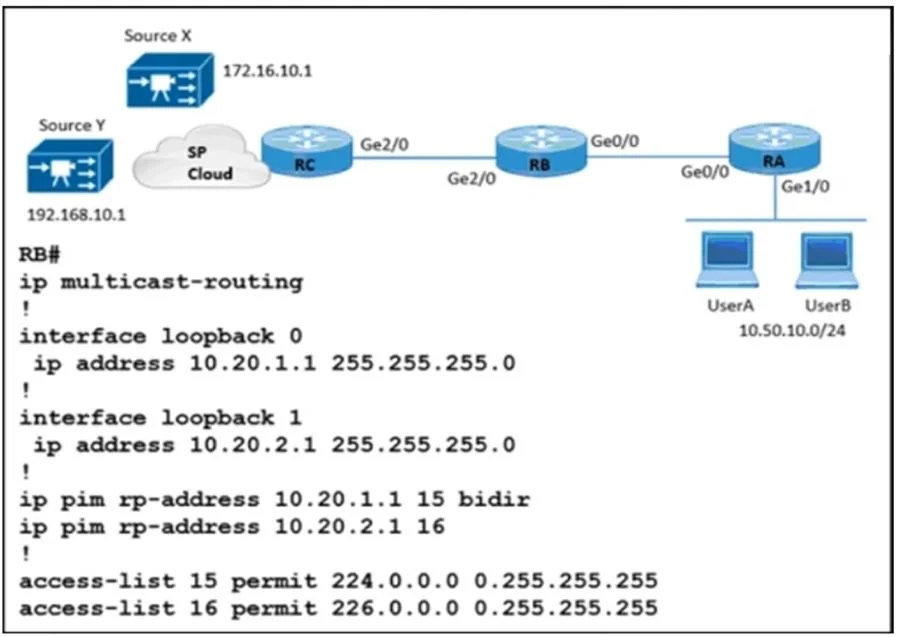
Refer to the exhibit. The service provider is serving hosts with two different multicast streams from source X and source Y. Source X is multicast group 224.0.0.0/8, and source Y is multicast group…
The correct answer is B. Add ip pim bidir-enable in global mode on RB. The network needs to support bidirectional PIM for Source X using RP 10.20.1.1 and regular PIM Sparse Mode for Source Y using RP 10.20.2.1. Enabling ip pim bidir-enable on RB allows it to participate in or act as a Bidirectional PIM router, which is crucial for the first…
Question
Refer to the exhibit. The service provider is serving hosts with two different multicast streams from source X and source Y. Source X is multicast group 224.0.0.0/8, and source Y is multicast group 226.0.0.0/8. Multicast source X should send its stream through bidirectional RP address 10.20.1.1, and multicast source Y should send its stream through RP address 10.20.2.1. Which configuration meets these requirements?
Exhibit
Options
- AEnable ip pim ssm default on RA and RB.
- BAdd ip pim bidir-enable in global mode on RB.
- CPermit the source X and source Y IP addresses in the access list on RB.
- DSet PIM sparse mode with a static RP address of 10.20.2.1 on RA and RC.
How the community answered
(39 responses)- A3% (1)
- B92% (36)
- C5% (2)
Why each option
The network needs to support bidirectional PIM for Source X using RP 10.20.1.1 and regular PIM Sparse Mode for Source Y using RP 10.20.2.1. Enabling `ip pim bidir-enable` on RB allows it to participate in or act as a Bidirectional PIM router, which is crucial for the first requirement.
Enabling `ip pim ssm default` configures Source Specific Multicast, which uses (S,G) channels and does not involve RPs or bidirectional PIM functionality.
Adding the `ip pim bidir-enable` command in global configuration mode on RB enables Bidirectional PIM functionality on the router, which is a prerequisite for supporting a bidirectional RP for multicast group 224.0.0.0/8 as required. This command allows the router to create and maintain shared trees for bidirectional groups, enabling many-to-many communication.
Permitting source IP addresses in an access list is typically used for defining valid sources or for RP-group mappings, but it does not enable bidirectional PIM itself.
Setting PIM sparse mode with a static RP for 10.20.2.1 on RA and RC addresses the second requirement for Source Y but does not enable bidirectional PIM for Source X.
Concept tested: PIM Bidirectional (Bi-dir) configuration
Source: https://www.cisco.com/c/en/us/td/docs/ios-xml/ios/ipmulti/command/imc-cr-book/imc-i2.html#wp2506240228
Topics
Community Discussion
No community discussion yet for this question.