
350-501 · Question #388
Refer to the exhibit. An engineer with an employee 10:4350:47:853 is implementing IS-IS as the new routing protocol in the network. All routers in the network operate as Level 2 routers in the same…
The correct answer is C. 48.0133.532b.ca14.6915.21311.f40f.1626.bb98.00. To establish IS-IS connectivity between R1 and R3 in the same Level 2 private autonomous system, R3's NET address must share the identical Area ID as R1, possess a unique System ID, and have an NSEL of 00.
Question
Refer to the exhibit. An engineer with an employee 10:4350:47:853 is implementing IS-IS as the new routing protocol in the network. All routers in the network operate as Level 2 routers in the same private autonomous system, and the three branches are connected via dark fibre. The engineer has already implemented IS-IS on router R1 with NET address 49.0133.532b.ca14.6915.21311.F40F.1B3a.ba10.00. Which IS-IS NET address configuration must be implemented on R3 to establish IS-IS connectivity?
Exhibit
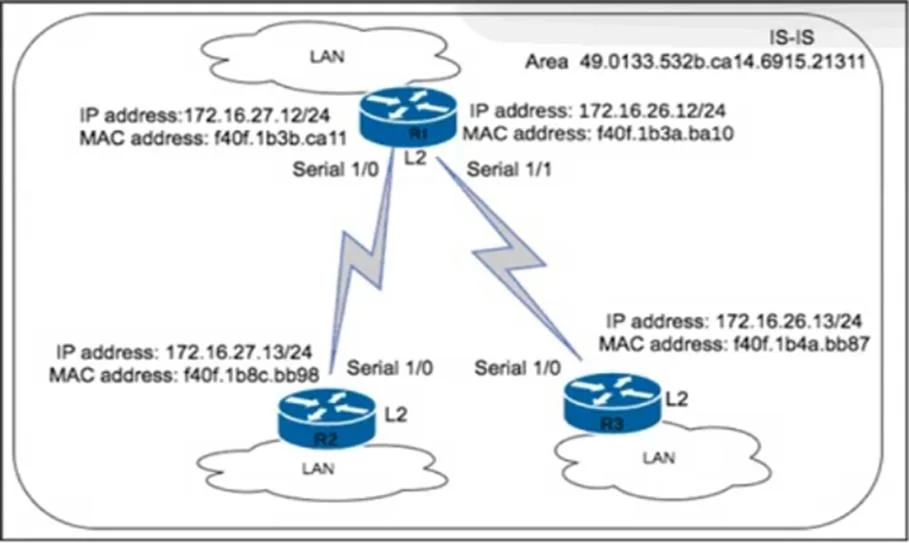
Options
- A49.0133.532b.ca14.6915.21311.f40f.1b4a.bb87.00
- B49.0135.332b.ca14.6975.28371.1721.1b3b.ca11.10
- C48.0133.532b.ca14.6915.21311.f40f.1626.bb98.00
- D49.0133.532b.ca14.6915.21311.1721.1b4a.0013.01
How the community answered
(25 responses)- A16% (4)
- B4% (1)
- C72% (18)
- D8% (2)
Why each option
To establish IS-IS connectivity between R1 and R3 in the same Level 2 private autonomous system, R3's NET address must share the identical Area ID as R1, possess a unique System ID, and have an NSEL of `00`.
This option is incorrect because while it shares the Area ID, has a unique System ID, and the correct NSEL, it uses AFI `49`. Given that option C is the correct answer with AFI `48`, it implies AFI can differ, and `48` might be preferred in this context.
This option is incorrect because its Area ID (`0135.332b.ca14.6975.28371`) is different from R1's, and its NSEL is `10` instead of the standard `00` for a router.
For IS-IS Level 2 routers in the same area to establish adjacency, their Area ID portion of the NET address must match. R1's Area ID, derived from its NET `49.0133.532b.ca14.6915.21311.F40F.1B3a.ba10.00`, is `0133.532b.ca14.6915.21311`. Option C has the same Area ID, a unique System ID (`f40f.1626.bb98`), and the standard NSEL `00`, fulfilling the requirements. The AFI can differ (`48` vs `49`) while still allowing adjacency if the Area ID is otherwise identical.
This option is incorrect because its NSEL (`01`) is not the standard `00` for a router, even though its Area ID matches R1's and its System ID is unique.
Concept tested: IS-IS NET address components and adjacency
Source: https://www.cisco.com/c/en/us/td/docs/iosxr/ncs5000/routing/70x/b-routing-cg-ncs5000-70x/b-routing-cg-ncs5000-70x_chapter_0100.html
Topics
Community Discussion
No community discussion yet for this question.