
350-501 · Question #387
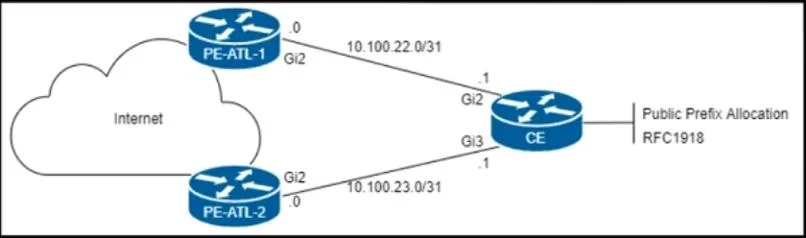
Refer to the exhibit. The CE router is peering with both PE routers and advertising a public prefix to the internet. Routing to and from this prefix will be asymmetric under certain network…
The correct answer is D. ip verify unicast source reachable-via any. To validate reverse packet forwarding on Gi2 interfaces, drop RFC1918 traffic, and allow for asymmetric routing, the ip verify unicast source reachable-via any command should be applied, as it checks reachability via any interface without relying on the default route for…
Question
Refer to the exhibit. The CE router is peering with both PE routers and advertising a public prefix to the internet. Routing to and from this prefix will be asymmetric under certain network conditions, but packets must not be discarded. Which configuration must an engineer apply to the two PE routers so that they validate reverse packet forwarding for packets entering their Gi2 interfaces and drop traffic from the RFC1918 space?
Exhibit
Options
- Aip verify unicast source reachable-via rx allow-default
- Binterface GigabitEthernet 2
- Cip verify unicast source reachable-via any allow-default
- Dip verify unicast source reachable-via any
How the community answered
(52 responses)- A13% (7)
- B4% (2)
- C6% (3)
- D77% (40)
Why each option
To validate reverse packet forwarding on Gi2 interfaces, drop RFC1918 traffic, and allow for asymmetric routing, the `ip verify unicast source reachable-via any` command should be applied, as it checks reachability via any interface without relying on the default route for private addresses.
This option uses `reachable-via rx` (strict mode), which would drop packets if the reverse path is not through the ingress interface, directly conflicting with the requirement to allow asymmetric routing.
This option merely enters interface configuration mode and does not provide any uRPF (Unicast Reverse Path Forwarding) configuration.
This option, `allow-default`, permits traffic if the source IP is reachable via any interface or the default route. If the default route points to the internet, it could inadvertently permit RFC1918 traffic if no more specific route exists, violating the requirement to drop RFC1918 traffic.
The `ip verify unicast source reachable-via any` command ensures that a packet's source IP address exists in the FIB (Forwarding Information Base) as reachable via *any* interface. This prevents RFC1918 addresses from public-facing interfaces (as they wouldn't be in the FIB) while accommodating asymmetric routing paths by not requiring the reverse path to be the ingress interface.
Concept tested: Unicast Reverse Path Forwarding (uRPF)
Source: https://www.cisco.com/c/en/us/td/docs/ios-xml/ios/sec_data_urpf/configuration/xe-16/sec-data-urpf-xe-16-book/sec-data-urpf-cfg.html
Topics
Community Discussion
No community discussion yet for this question.