
350-501 · Question #371
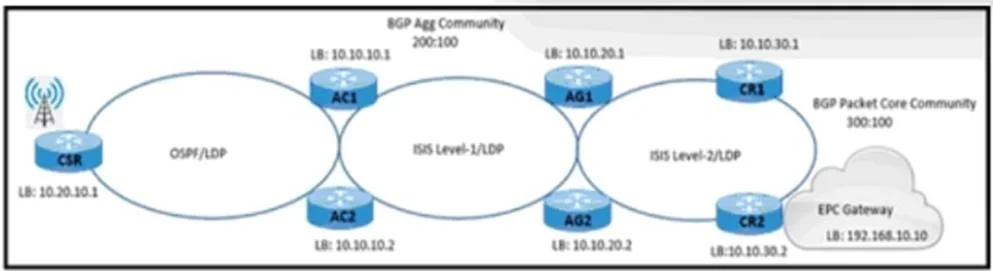
Refer to the exhibit. A NOC engineer is configuring label-based forwarding from CSR to the EPC gateway. Cell-site operation and maintenance for IPv4 traffic between 10.20.10.1 and 192.168.10.10 is…
The correct answer is B. Apply the BGP_Egress_Filter route policy to the BGP neighbor-group packet core on AG1. To complete the configuration for label-based forwarding from CSR to the EPC gateway, applying the existing BGP_Egress_Filter route policy to the BGP neighbor-group on AG1 is a crucial step for controlling route advertisements and ensuring proper MPLS forwarding.
Question
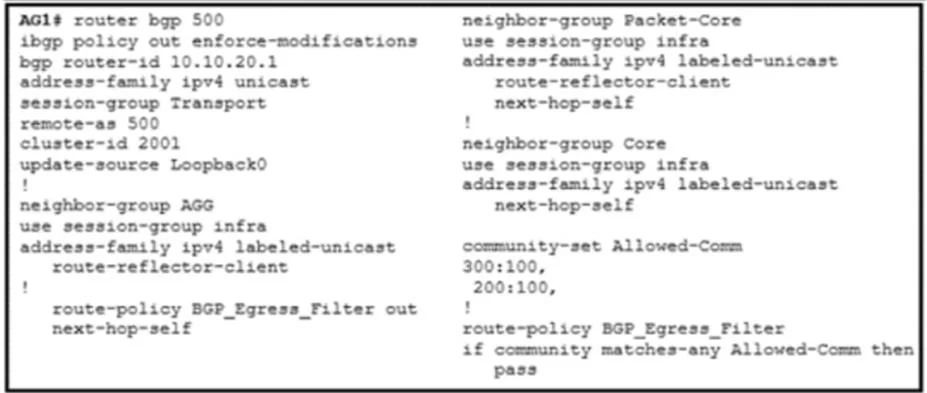
Refer to the exhibit. A NOC engineer is configuring label-based forwarding from CSR to the EPC gateway. Cell-site operation and maintenance for IPv4 traffic between 10.20.10.1 and 192.168.10.10 is already up. CR1 and CR2 are configured as route reflectors for AG1 and AG2. Which action completes the configuration?
Exhibits
Options
- ARemove address-family labeled-unicast from the BGP session-group infra on AG1 for neighbor-
- BApply the BGP_Egress_Filter route policy to the BGP neighbor-group packet core on AG1.
- CConfigure AG1 to allocate a label to the BGP routes that are received in the BGP session group
- DConfigure AG1 to allow the 300:100 and 200:100 communities in the BGP_Egress_Filter route
How the community answered
(46 responses)- A2% (1)
- B80% (37)
- C11% (5)
- D7% (3)
Why each option
To complete the configuration for label-based forwarding from CSR to the EPC gateway, applying the existing BGP_Egress_Filter route policy to the BGP neighbor-group on AG1 is a crucial step for controlling route advertisements and ensuring proper MPLS forwarding.
Removing the 'address-family labeled-unicast' from a BGP session group would disable the exchange of labels, which is contrary to configuring label-based forwarding.
For label-based forwarding (MPLS) to an EPC gateway, BGP is used to exchange routes and labels. Applying a BGP egress filter route policy to the appropriate neighbor-group, such as 'packet core' on AG1, is a common and necessary step to control which routes (and their associated labels) are advertised out of AG1, thereby completing the policy enforcement for the forwarding path.
A router typically allocates labels for prefixes it advertises to its neighbors, not necessarily for routes it receives in a BGP session group, making this statement potentially incorrect or at least not the primary completing action for outbound label allocation.
Configuring AG1 to allow specific communities in the BGP_Egress_Filter route implies modifying the filter's definition, not the act of applying an already defined filter, which is what 'completes the configuration' usually suggests.
Concept tested: BGP policy application for MPLS Labeled Unicast
Source: https://www.cisco.com/c/en/us/td/docs/ios-xml/ios/iproute_bgp/configuration/xe-3s/bgp-xe-3s-book/bgp-route-policy.html
Topics
Community Discussion
No community discussion yet for this question.