
350-501 · Question #370
Refer to the exhibit. EIGRP is running between routers R5 and R1, and OSPF is used in the rest of the network. Users in a network attached to router R3 need to access a server connected to R5. Which…
The correct answer is A. Configure redistribution using route maps to filter the routes that are shared. To allow R3 users to access a server on R5 while preventing other EIGRP routes from being shared into OSPF, route redistribution must be configured between EIGRP and OSPF on R1, precisely controlled by route maps.
Question
Refer to the exhibit. EIGRP is running between routers R5 and R1, and OSPF is used in the rest of the network. Users in a network attached to router R3 need to access a server connected to R5. Which task must the engineer perform so that only the users attached to R3 are able to access the server, but no other network is shared to OSPF?
Exhibit
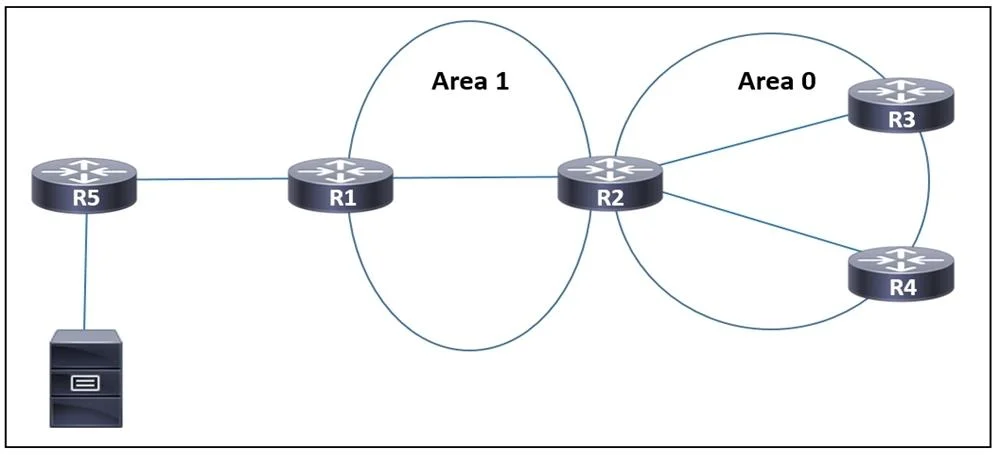
Options
- AConfigure redistribution using route maps to filter the routes that are shared
- BConfigure redistribution using an offset list to filter the routes that are shared.
- CConfigure an OSPF virtual link between R1 and R3 to route traffic between the two areas.
- DConfigure R1 as a stub router for EIGRP and OSPF so that only the default route is shared
How the community answered
(31 responses)- A84% (26)
- B3% (1)
- C10% (3)
- D3% (1)
Why each option
To allow R3 users to access a server on R5 while preventing other EIGRP routes from being shared into OSPF, route redistribution must be configured between EIGRP and OSPF on R1, precisely controlled by route maps.
To allow specific network access (R3 to R5 server) across different routing protocols (EIGRP and OSPF) while precisely controlling which routes are advertised, redistribution must be configured on R1. Route maps are the most effective and flexible tool to filter specific routes during redistribution, ensuring only the necessary routes (e.g., the server's network on R5) are shared into OSPF and no other unwanted EIGRP networks are advertised.
An offset list modifies the metric of a route to influence path selection but does not filter routes from being advertised or redistributed entirely.
An OSPF virtual link is used to connect an OSPF area to the backbone (Area 0) through another area, or to connect non-contiguous Area 0 segments; it is not a mechanism for filtering routes during redistribution between different routing protocols.
Configuring a router as a stub in EIGRP or OSPF primarily affects how routes are advertised within those protocols or areas, typically by limiting them to default routes, which contradicts the need to share a specific server route.
Concept tested: Route redistribution with filtering (route maps)
Source: https://www.cisco.com/c/en/us/td/docs/ios-xml/ios/iproute_pi/configuration/15-mt/iri-15-mt-book/iri-rdstrb-rte-mps.html
Topics
Community Discussion
No community discussion yet for this question.