
350-501 · Question #357
Refer to the exhibit. In the service provider network, routers PE1, PE2, and PE4 have access to the internet and provide access to customer networks. Router PE3 is used for access to other customer…
The correct answer is A. On PE1, configure the internet VRF with import route target 102:102. E. On PE2, configure the CE1 VRF with import route target 101:101. To redirect CE1's internet access from PE2 to PE1, the internet VRF on PE1 must be configured to participate in the general internet routing domain, and CE1's VRF on PE2 must import internet routes specifically exported by PE1.
Question
Refer to the exhibit. In the service provider network, routers PE1, PE2, and PE4 have access to the internet and provide access to customer networks. Router PE3 is used for access to other customer systems. In accordance with a new SLA, an engineer is updating settings on this network so that router CE1 accesses the internet via PE1 instead of PE2. Which two tasks must the engineer perform to complete the process? (Choose two.)
Exhibit
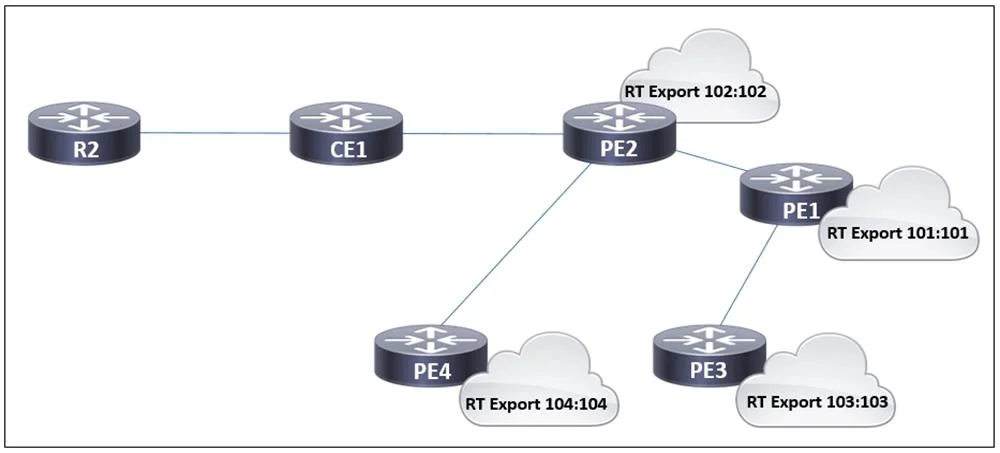
Options
- AOn PE1, configure the internet VRF with import route target 102:102.
- BOn PE1 and PE4, configure the internet VRF with import route targets 102:102 and 104:104.
- COn PE2, configure the internet VRF with import route target 102:102.
- DOn PE2 and PE3, configure the internet VRF with import route target 101:101.
- EOn PE2, configure the CE1 VRF with import route target 101:101.
How the community answered
(45 responses)- A76% (34)
- B7% (3)
- C13% (6)
- D4% (2)
Why each option
To redirect CE1's internet access from PE2 to PE1, the internet VRF on PE1 must be configured to participate in the general internet routing domain, and CE1's VRF on PE2 must import internet routes specifically exported by PE1.
Configuring PE1's internet VRF to import route target 102:102 ensures that PE1 properly participates in the shared internet routing domain within the service provider network, allowing it to aggregate and distribute internet-bound routes. This step is a prerequisite for PE1 to function as an effective internet gateway for CE1.
This option configures PE1 to import a route target that PE1 itself would likely export for general internet connectivity, and adding PE4 without specific instructions doesn't align with the requirement to shift CE1's traffic via PE1.
Configuring PE2's internet VRF to import 102:102 (which likely represents PE1's internet routes or general internet routes) would potentially allow PE2's internet VRF to learn internet routes from PE1, but it doesn't directly configure CE1 to use PE1 for internet, nor does it necessarily stop PE2 from advertising its own internet routes to CE1.
This option modifies PE2 and PE3 to import 101:101 into their internet VRFs. While PE2 importing 101:101 would mean its internet VRF learns CE1's routes, this does not direct CE1's internet traffic towards PE1. PE3 is not an internet-facing router for this scenario.
Configuring CE1's VRF on PE2 to import route target 101:101 directs CE1 to receive internet routes from PE1. This implies that PE1's internet VRF (or a routing policy on PE1) is configured to export internet routes tagged with 101:101 specifically for CE1, making PE1 the preferred path for CE1's internet traffic.
Concept tested: MPLS VPN route target configuration
Source: https://www.cisco.com/c/en/us/td/docs/ios-xml/ios/mp_l3_vpn/configuration/xe-16/mp-l3-vpn-xe-16-book/mpls-l3vpn-cfg.html
Topics
Community Discussion
No community discussion yet for this question.