
350-501 · Question #356
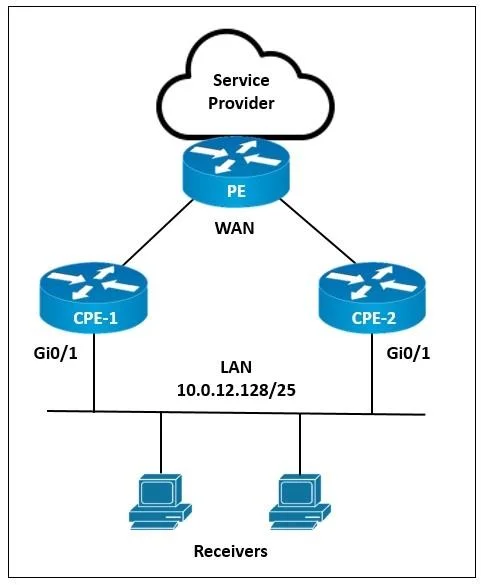
Refer to the exhibit. A network engineer is implementing multicast services on CPE-1 and CPE-2. CPE-1 must be configured as the preferred IGMP querier for the LAN segment. PIM-SM must be implemented…
The correct answer is A. On CPE-1: interface GigabitEthernet0/1 ip address 10.0.12.129 255.255.255.128 ip pim sparse-. The engineer must configure CPE-1 with a lower IP address (10.0.12.129) than CPE-2 to ensure it becomes the preferred IGMP querier, and both routers must use IGMPv2 to support only (*, G) joins on the LAN segment.
Question
Refer to the exhibit. A network engineer is implementing multicast services on CPE-1 and CPE-2. CPE-1 must be configured as the preferred IGMP querier for the LAN segment. PIM-SM must be implemented on the LAN interfaces with an IGMP version that supports (*, G) joins only. Which configurations must the engineer implement on CPE-1 and CPE- 2?
Exhibit
Options
- AOn CPE-1: interface GigabitEthernet0/1 ip address 10.0.12.129 255.255.255.128 ip pim sparse-
- BOn CPE-1: interface GigabitEthernet0/1 ip address 10.0.12.130 255.255.255.128 ip pim sparse-
- COn CPE-1: interface GigabitEthernet0/1 ip address 10.0.12.130 255.255.255.128 ip pim sparse-
- DOn CPE-1: interface GigabitEthernet0/1 ip address 10.0.12.129 255.255.255.128 ip pim sparse-
How the community answered
(60 responses)- A85% (51)
- B2% (1)
- C5% (3)
- D8% (5)
Why each option
The engineer must configure CPE-1 with a lower IP address (10.0.12.129) than CPE-2 to ensure it becomes the preferred IGMP querier, and both routers must use IGMPv2 to support only (*, G) joins on the LAN segment.
CPE-1 is assigned the IP address 10.0.12.129, which is lower than CPE-2's 10.0.12.130, making it the preferred IGMP querier on the shared LAN segment due to the lowest IP address election rule. Both routers are configured for IGMPv2, which strictly supports (*, G) joins, aligning with the requirement to support *only* (*, G) joins, unlike IGMPv3 which also supports (S, G) joins. PIM sparse-mode is correctly enabled on both interfaces.
CPE-1 is assigned a higher IP address (10.0.12.130) than CPE-2, meaning CPE-2 would be the preferred querier, and IGMPv3 supports both (*,G) and (S,G) joins, violating the '(*,G) joins only' requirement.
CPE-1 is assigned a higher IP address (10.0.12.130) than CPE-2, meaning CPE-2 would be the preferred querier.
IGMPv3 is configured, which supports (S, G) joins in addition to (*, G) joins, violating the requirement to support '(*, G) joins only'.
Concept tested: IGMP querier election and PIM-SM configuration
Source: https://www.cisco.com/c/en/us/td/docs/ios-xml/ios/ipmulti/command/imc-cr-book/imc-cr-i1.html#wp4690325018
Topics
Community Discussion
No community discussion yet for this question.