
350-501 · Question #303
Refer to the exhibit. An engineer working for a private telecommunication company with an employee id: 3414:81:713 is implementing this network, in which: - Routers R1A and R1B are eBGP neighbors…
The correct answer is C. Configure router R2A as a route reflector to advertise the iBGP learned prefix from router R3A to. Due to the iBGP split-horizon rule, R2A will not advertise prefixes learned from R1A to R3A; therefore, R2A must be configured as a route reflector to ensure all iBGP peers in the AS receive the advertised routes.
Question
Refer to the exhibit. An engineer working for a private telecommunication company with an employee id: 3414:81:713 is implementing this network, in which:
- Routers R1A and R1B are eBGP neighbors.
- iBGP is configured within AS 65515 and AS 65516.
- Network 192.168.2.0/24 is shared with AS 65516.
- Router R3A has an iBGP relationship with router R2A only.
- Router R2A has an iBGP relationship with routers R1A and R3A.
Which additional task must the engineer perform to complete the configuration?
Exhibit
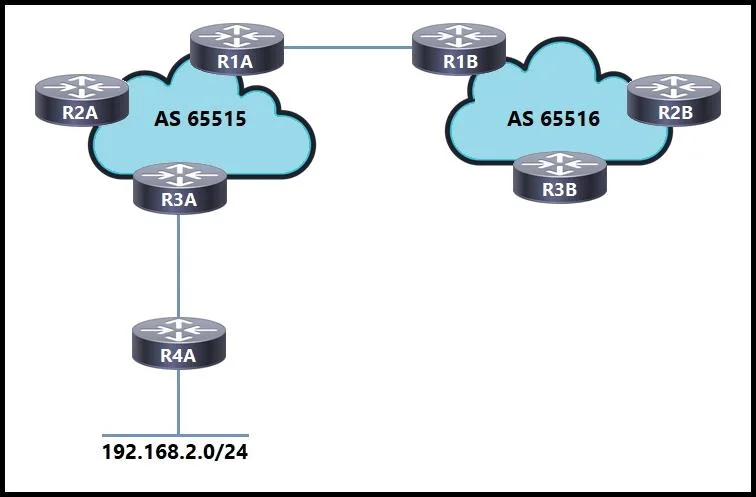
Options
- AConfigure router R2A to use the next-hop-self attribute when advertising the learned route to
- BConfigure router R3A to redistribute route 192.168.2.0/24 into the configured IGP to advertise the
- CConfigure router R2A as a route reflector to advertise the iBGP learned prefix from router R3A to
- DConfigure router R1A with a static route to 192.168.2.0/24 that is redistributed into BGP.
How the community answered
(62 responses)- A11% (7)
- B2% (1)
- C84% (52)
- D3% (2)
Why each option
Due to the iBGP split-horizon rule, R2A will not advertise prefixes learned from R1A to R3A; therefore, R2A must be configured as a route reflector to ensure all iBGP peers in the AS receive the advertised routes.
The `next-hop-self` attribute is typically used to ensure the next-hop for a route is reachable within the AS, but the primary issue preventing route advertisement between R1A and R3A via R2A is the iBGP split-horizon rule.
Redistributing a BGP-learned route into an IGP on R3A would not solve the problem of R3A receiving the BGP prefix itself if R2A doesn't reflect it due to split-horizon, and is generally discouraged due to potential routing issues.
The iBGP split-horizon rule prevents a BGP router from advertising prefixes learned from one iBGP peer to another iBGP peer. In this topology, R2A learns 192.168.2.0/24 from R1A (an iBGP peer) and would not advertise it to R3A (another iBGP peer). Configuring R2A as a route reflector allows it to reflect routes between its clients (R1A and R3A), ensuring R3A receives the 192.168.2.0/24 prefix.
Configuring a static route on R1A to 192.168.2.0/24 that is then redistributed into BGP would make R1A the origin of the route, not AS 65516, and would not address the iBGP split-horizon issue preventing R3A from learning the route from its true origin.
Concept tested: iBGP split-horizon and Route Reflectors
Source: https://www.cisco.com/c/en/us/td/docs/ios-xml/ios/iproute_bgp/configuration/15-mt/irg-15-mt-book/irg-route-reflector.html
Topics
Community Discussion
No community discussion yet for this question.