
350-501 · Question #295
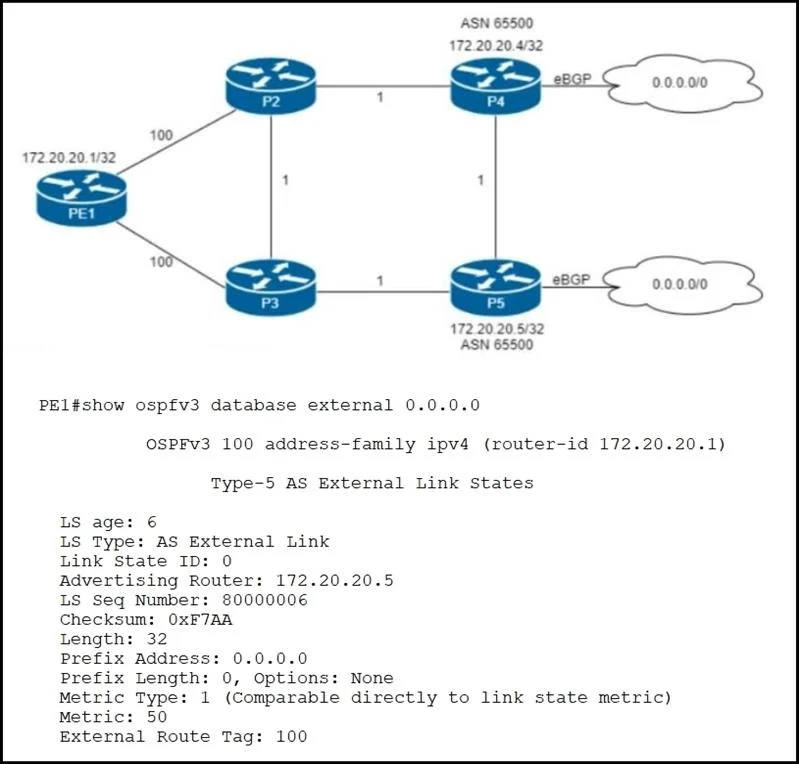
Refer to the exhibit. Routers P4 and P5 receive the 0.0.0.0/0 route from the ISP via eBGP peering. P4 is the primary Internet gateway router, and P5 is its backup. P5 is already advertising a…
The correct answer is A. configure terminal. To make P4 the primary internet gateway, it must advertise a default route into OSPF with a better metric than P5, using default-information originate since it already receives a default route via eBGP, and include any necessary area summarization.
Question
Refer to the exhibit. Routers P4 and P5 receive the 0.0.0.0/0 route from the ISP via eBGP peering. P4 is the primary Internet gateway router, and P5 is its backup. P5 is already advertising a default route into the OSPF domain. Which configuration must be applied to P4 so that it advertises a default route into OSPF and becomes the primary Internet gateway for the network?
Exhibit
Options
- Aconfigure terminal
- Bconfigure terminal
- Cconfigure terminal
- Dconfigure terminal
How the community answered
(21 responses)- A71% (15)
- B5% (1)
- C5% (1)
- D19% (4)
Why each option
To make P4 the primary internet gateway, it must advertise a default route into OSPF with a better metric than P5, using `default-information originate` since it already receives a default route via eBGP, and include any necessary area summarization.
The `default-information originate metric 100 metric-type 1` command ensures P4 advertises a default route into OSPF with a lower metric (100) than P5 (200), making it the preferred path. Since P4 already receives a default route via eBGP, the `always` keyword is not needed, preventing blackholing if the external route is lost. The `area 0 range ... not-advertise` command configures OSPF summarization to prevent specific subnets from being advertised from Area 0.
The `always` keyword would cause P4 to advertise a default route even if it loses its eBGP-learned default route, potentially leading to traffic blackholing.
Similar to B, the `always` keyword is inappropriate for a router that relies on an external default route and needs to stop advertising it if the external route disappears.
While `default-information originate` with the correct metric is present, this option omits the `area 0 range ... not-advertise` command which is included in the correct answer, implying it's part of the required configuration.
Concept tested: OSPF default route origination and metric manipulation
Source: https://www.cisco.com/c/en/us/td/docs/ios-xml/ios/iproute_ospf/configuration/15-mt/iro-ospf-15-mt-book/iro-ospf-dflt-route.html
Topics
Community Discussion
No community discussion yet for this question.