
350-501 · Question #275
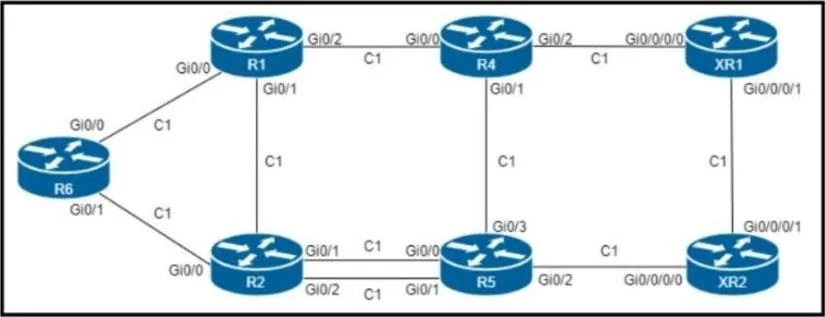
Refer to the exhibit. An engineer configured R6 as the headend LSR of an RSVP-TE LSP to router XR2, with the dynamic path signaled as R6-R2-R5-XR2. and set the OSPF cost of all links to 1. MPLS…
The correct answer is A. The R6 backup tunnel path R6-R1-R4-R5. C. The R2 backup tunnel path R2-R1-R4-XR1-XR2. To implement NNHOP backup for an RSVP-TE LSP, tunnels are created from the Point of Local Repair (PLR) to the Next-Next Hop (NNHOP) router, bypassing the directly adjacent next hop.
Question
Refer to the exhibit. An engineer configured R6 as the headend LSR of an RSVP-TE LSP to router XR2, with the dynamic path signaled as R6-R2-R5-XR2. and set the OSPF cost of all links to 1. MPLS autotunnel backup Is enabled on all routers to protect the LSP. Which two NNHOP backup tunnels should the engineer use to complete the implementation? (Choose two.)
Exhibit
Options
- AThe R6 backup tunnel path R6-R1-R4-R5.
- BThe R2 backup tunnel path R2-R5 across the alternate link.
- CThe R2 backup tunnel path R2-R1-R4-XR1-XR2.
- DThe R6 backup tunnel path R6-R2-R5
- EThe R6 backup tunnel path R6-R1-R2.
How the community answered
(26 responses)- A54% (14)
- B4% (1)
- D31% (8)
- E12% (3)
Why each option
To implement NNHOP backup for an RSVP-TE LSP, tunnels are created from the Point of Local Repair (PLR) to the Next-Next Hop (NNHOP) router, bypassing the directly adjacent next hop.
For the R6-R2 segment of the primary LSP, R6 is the PLR, R2 is the NHOP, and R5 is the NNHOP. A backup tunnel path from R6-R1-R4-R5 bypasses R2 and reaches R5, thus acting as an NNHOP backup.
A backup tunnel from R2 directly to R5 across an alternate link would provide NHOP (link) protection for the R2-R5 link, not NNHOP protection to XR2.
For the R2-R5 segment of the primary LSP, R2 is the PLR, R5 is the NHOP, and XR2 is the NNHOP. A backup tunnel path from R2-R1-R4-XR1-XR2 bypasses R5 and reaches XR2, thus acting as an NNHOP backup.
The path R6-R2-R5 is part of the primary LSP path, not a distinct backup tunnel.
A backup tunnel from R6 to R2 via R1 (R6-R1-R2) would provide NHOP protection for the R6-R2 link, terminating at the NHOP, not the NNHOP (R5).
Concept tested: MPLS TE Fast Reroute (FRR) NNHOP backup tunnels
Source: https://www.cisco.com/c/en/us/td/docs/iosxr/mpls/te/b-mpls-te-cg-iosxr-62x/b-mpls-te-cg-iosxr-62x_chapter_010.html#concept_ghd_q2x_31b
Topics
Community Discussion
No community discussion yet for this question.