
350-501 · Question #108
Refer to the exhibit. When implementing an LDP protocol, an engineer experienced an issue between two directly connected routers and noticed that no LDP neighbor exists for 1.1.1.1. Which factor…
The correct answer is A. LDP needs to be enabled on the R2 physical interface. If no LDP neighbor forms between two directly connected routers, a common reason is that LDP has not been explicitly enabled on the physical interface of R2 connecting to R1.
Question
Refer to the exhibit. When implementing an LDP protocol, an engineer experienced an issue between two directly connected routers and noticed that no LDP neighbor exists for 1.1.1.1. Which factor should be the reason for this situation?
Exhibit
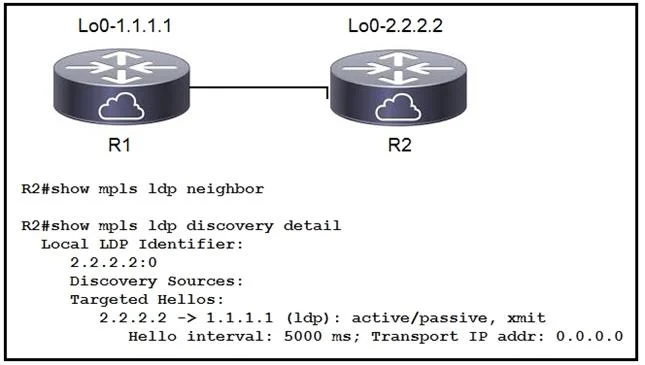
Options
- ALDP needs to be enabled on the R2 physical interface
- BR2 does not see any hellos from R1
- CLDP needs to be enabled on the R2 loopback interface
- DR2 sees the wrong type of hellos from R1
How the community answered
(61 responses)- A92% (56)
- B3% (2)
- C3% (2)
- D2% (1)
Why each option
If no LDP neighbor forms between two directly connected routers, a common reason is that LDP has not been explicitly enabled on the physical interface of R2 connecting to R1.
For LDP to establish an adjacency and exchange labels with a directly connected neighbor, it must be enabled on the participating physical interface of both routers (e.g., using 'mpls ip' or 'mpls ldp autoconfig' in interface configuration mode). Without this, LDP hellos are not sent or processed on that interface, preventing neighbor discovery.
While R2 not seeing hellos would prevent neighbor formation, the fundamental reason for that in this scenario is LDP not being enabled on the interface itself.
While a loopback interface is often used as the LDP router ID, enabling LDP on the loopback alone does not enable it on the physical interface for direct neighbor discovery.
Seeing the 'wrong type' of hellos implies hellos are being exchanged but are incompatible, which is less likely than LDP simply not being enabled on the interface, preventing any hellos.
Concept tested: LDP neighbor formation requirements - interface enablement
Source: https://www.cisco.com/c/en/us/td/docs/ios-xml/ios/mpls/configuration/xe-16/mp-xe-16-book/mp-ldp-ov.html
Topics
Community Discussion
No community discussion yet for this question.