
350-401 · Question #808
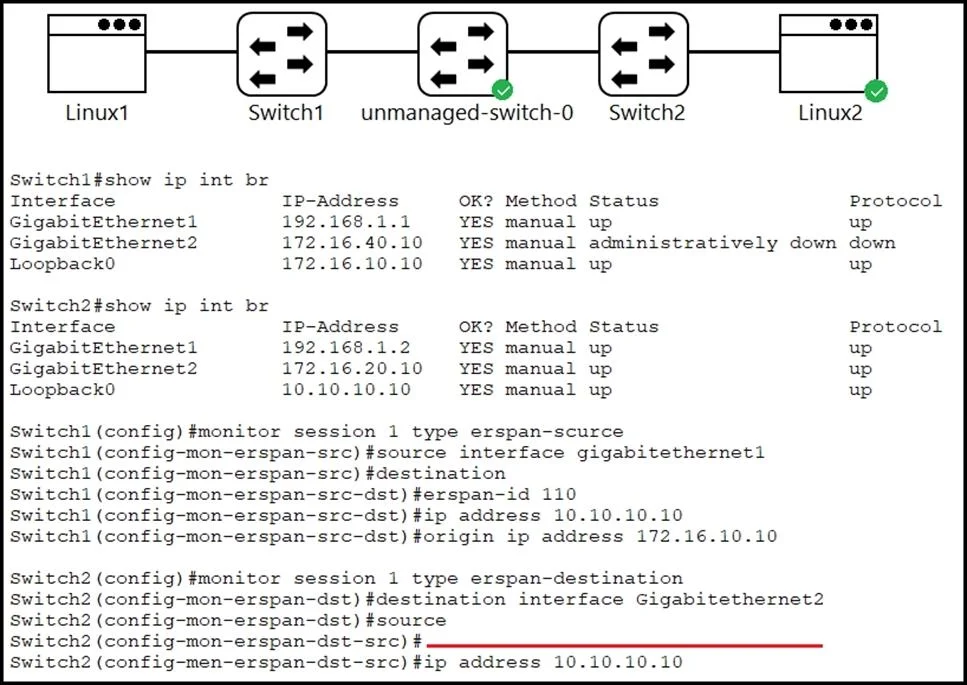
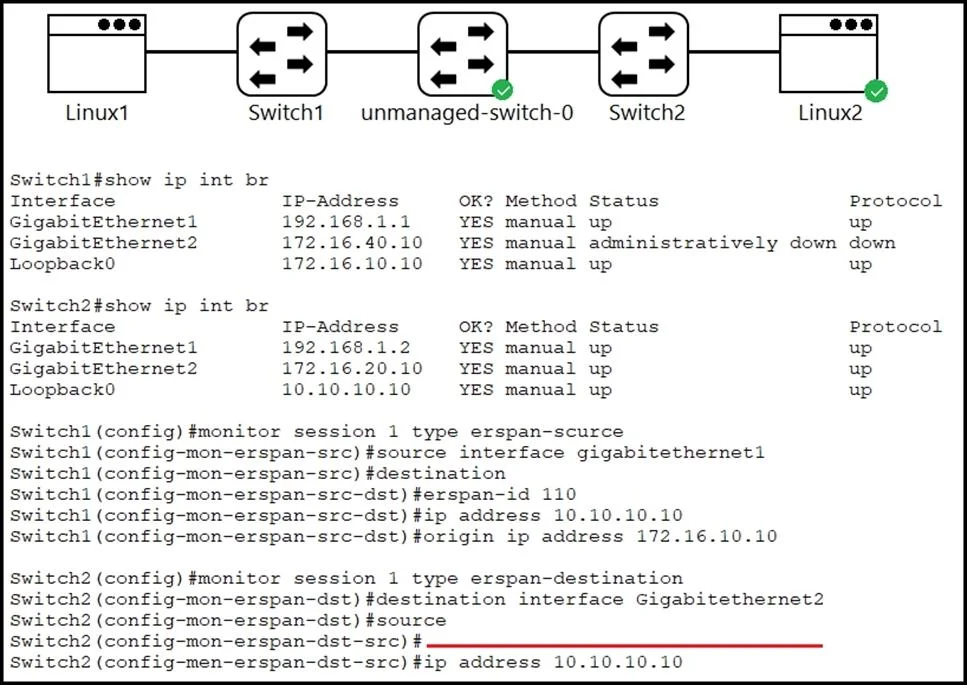
Refer to the exhibit. An engineer must configure an ERSPAN tunnel that mirrors traffic from linux1 on Switch1 to Linux2 on Switch2. Which command must be added to the destination configuration to…
The correct answer is D. (config-mon-erspan-dst-src)# erspan-id 110. To enable an ERSPAN tunnel on the destination, the erspan-id command must be configured to match the ID used by the source.
Question
Exhibits
Options
- A(config-mon-erspan-dst-src)# origin ip address 172.16.10.10
- B(config-mon-erspan-dst-src)# erspan-id 172.16.10.10
- C(config-mon-erspan-dst-src)# no shut
- D(config-mon-erspan-dst-src)# erspan-id 110
How the community answered
(46 responses)- A15% (7)
- B7% (3)
- C2% (1)
- D76% (35)
Why each option
To enable an ERSPAN tunnel on the destination, the `erspan-id` command must be configured to match the ID used by the source.
The `origin ip address` command is used on the ERSPAN source to specify its IP address, not on the destination.
The `erspan-id` takes an integer as an argument, not an IP address.
While `no shut` is used to enable interfaces or features, the `erspan-id` command is specifically required to define and associate the ERSPAN session for the tunnel to function.
For an ERSPAN tunnel to be established and enabled between a source and destination, both ends must be configured with a matching `erspan-id`, which is a numerical identifier for the ERSPAN session.
Concept tested: ERSPAN destination configuration
Source: https://www.cisco.com/c/en/us/td/docs/ios-xml/ios/netflow/configuration/xe-3s/nf-xe-3s-book/nf-erspan.html
Topics
Community Discussion
No community discussion yet for this question.