
350-401 · Question #1304
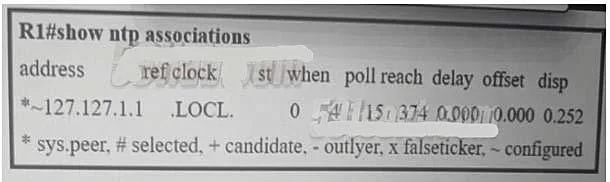
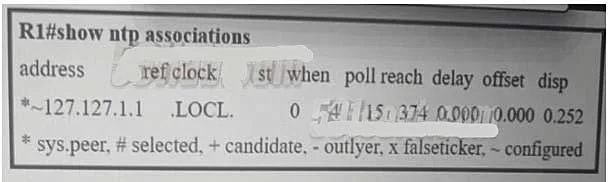
Refer to the exhibit. What can be determined from the NTP association information from R1?
The correct answer is A. R1 is an NTP master and is using its internal clock as a time source. The NTP association information indicates that R1 is synchronizing with its own internal clock, identified by 127.127.1.1, and is designated as an NTP master capable of providing time services.
Question
Exhibits
Options
- AR1 is an NTP master and is using its internal clock as a time source.
- BR1 is an NTP client and peers with an NTP master of 127.127.1.1
- CR1 is an NTP client and peers with an NTP master set to Stratum 0.
- DR1 is an NTP master set to Stratum 0.
How the community answered
(39 responses)- A62% (24)
- B23% (9)
- C10% (4)
- D5% (2)
Why each option
The NTP association information indicates that R1 is synchronizing with its own internal clock, identified by 127.127.1.1, and is designated as an NTP master capable of providing time services.
The exhibit likely shows R1 synchronizing to the loopback address 127.127.1.1, which represents its own internal clock, and displaying a stratum value (typically 8) that indicates it is acting as a master, capable of supplying time to other NTP clients. This is usually configured with the 'ntp master' command.
While R1 might be peering with 127.127.1.1, the presence of 'ntp master' command output would convert it from a pure client into a server providing time, making it an NTP master rather than solely a client.
Stratum 0 is a theoretical stratum for a primary reference clock and is not an operational stratum for a network device; devices operate at Stratum 1 or higher.
Stratum 0 is not an operational stratum. An NTP master on a router would typically operate at a higher stratum (e.g., Stratum 8 by default when using the 'ntp master' command).
Concept tested: NTP master clock configuration and status
Source: https://www.cisco.com/c/en/us/td/docs/ios/12_0/netmgmt/configuration/guide/nmntp.html
Topics
Community Discussion
No community discussion yet for this question.