
350-401 · Question #1251
Lab Simulation 33 Guidelines This is a lab item in which tasks will be performed on virtual devices. - Refer to the Tasks tab to view the tasks for this lab item. - Refer to the Topology tab to…
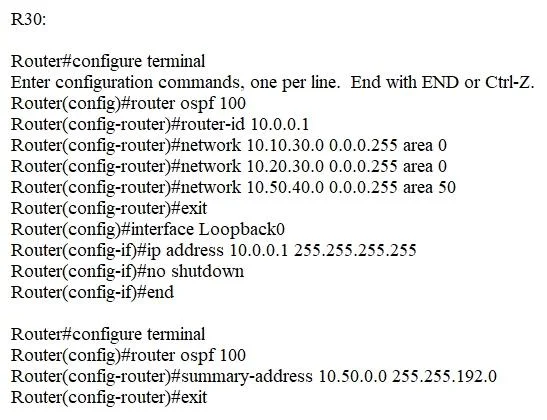
The correct configuration requires enabling OSPF Process ID 100 on R30, explicitly setting the Router ID to the Loopback0 interface address, advertising all connected networks (10.10.30.0/24, 10.20.30.0/24, and 10.50.40.0/24) using network statements with appropriate wildcard…
Question
Lab Simulation 33 Guidelines This is a lab item in which tasks will be performed on virtual devices.
- Refer to the Tasks tab to view the tasks for this lab item.
- Refer to the Topology tab to access the device console(s) and perform the tasks.
- Console access is available for all required devices by clicking the device icon or using the
tab(s) above the console window.
- All necessary preconfigurations have been applied.
- Do not change the enable password or hostname for any device.
- Save your configurations to NVRAM before moving to the next item.
- Click Next at the bottom of the screen to submit this lab and move to the next question.
- When Next is clicked, the lab closes and cannot be reopened.
Topology Tasks OSPF is preconfigured on all devices except R30. Configure R30 to complete these tasks. Task 1:
Configure OSPF according to the topology using these requirements:
- Use Process ID 100.
- Use Loopback0 for the Router ID.
- Advertise all networks into OSPF.
o Use network statements under the OSPF process to accomplish this task. Task 2:
Configure a/18 summary route for Area 50.
- Advertise only Type 3 LSAs into Area0.
Answer:
Exhibit
Explanation
The correct configuration requires enabling OSPF Process ID 100 on R30, explicitly setting the Router ID to the Loopback0 interface address, advertising all connected networks (10.10.30.0/24, 10.20.30.0/24, and 10.50.40.0/24) using network statements with appropriate wildcard masks, and configuring Area 50 as a Totally Stubby Area (using 'area 50 stub no-summary' on the ABR) to ensure only a Type 3 default LSA is advertised into Area 0 while also defining an inter-area summary route (/18) with the 'area 50 range' command. This approach ensures proper OSPF neighbor adjacency, correct LSA filtering between areas, and route summarization as required by the topology. Saving to NVRAM with 'copy running-config startup-config' ensures the configuration persists across reloads.
Topics
Community Discussion
No community discussion yet for this question.