
350-060 · Question #125
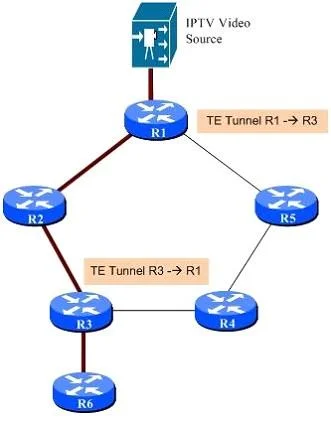
Refer to the exhibit. The network diagram shows a video service provider. The IPTV video source is connected to R1, whereas the clients are connected to R6. Traffic flows from R1 to R6 both as…
The correct answer is A. Use multitopology routing if the software supports it. F. Configure the TE tunnel to use autoroute announce as opposed to forwarding adjacency, and circumvent. See the full explanation below for the reasoning.
Question
Refer to the exhibit. The network diagram shows a video service provider. The IPTV video source is connected to R1, whereas the clients are connected to R6. Traffic flows from R1 to R6 both as unicast as well as multicast. Unicast traffic load is greater than multicast by several orders of magnitude. There are two paths from R1 to R6, each of them traverses through the R3 router. The path R1-R2-R3-R6 has a lower OSPF cost path compared to R1-R5-R4-R3-R6. The service provider took into account several design criteria and implemented TE tunnels with forwarding adjacency between R1 and R3 both from the perspective of load sharing as well as for fast reroute. Bringing up TE tunnels had the affect of dropping multicast traffic at the R3 router. On troubleshooting the issue, you noticed that the OSPF route to the source of multicast traffic was being learned over the TE tunnel, and this has caused the RPF check to fail. Considering this problem, what are two solutions to prevent multicast traffic from being affected by the RPF check failing due to the TE tunnel? (Choose two.)
Exhibit
Options
- AUse multitopology routing if the software supports it.
- BCreate a static mroute on R3 with the RPF pointing to the TE tunnel.
- CUse multicast-intact with forwarding adjacency.
- DEnable PIM on the TE tunnel on both of the headend routers.
- EEnable on the core facing links a new routing protocol such as another OSPF process or ISIS.
- FConfigure the TE tunnel to use autoroute announce as opposed to forwarding adjacency, and circumvent
How the community answered
(23 responses)- A78% (18)
- B4% (1)
- D4% (1)
- E13% (3)
Community Discussion
No community discussion yet for this question.