
350-001 · Question #72
Your network is suffering from regular outages. After troubleshooting, you learn that the transmit lead of a fiber uplink was damaged. Which two features can prevent the same issues in the future?…
The correct answer is B. loop guard D. UDLD. The STP loop guard feature provides additional protection against Layer 2 forwarding loops (STP loops). An STP loop is created when an STP blocking port in a redundant topology erroneously transitions to the forwarding state. This usually happens because one of the ports of a…
Question
Your network is suffering from regular outages. After troubleshooting, you learn that the transmit lead of a fiber uplink was damaged. Which two features can prevent the same issues in the future? (Choose two.)
Exhibit
Options
- Aroot guard
- Bloop guard
- CBPDU guard
- DUDLD
- EBPDU skew detection
How the community answered
(56 responses)- A5% (3)
- B75% (42)
- C4% (2)
- E16% (9)
Explanation
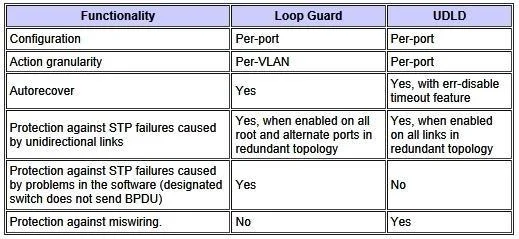
The STP loop guard feature provides additional protection against Layer 2 forwarding loops (STP loops). An STP loop is created when an STP blocking port in a redundant topology erroneously transitions to the forwarding state. This usually happens because one of the ports of a physically redundant topology (not necessarily the STP blocking port) no longer receives STP BPDUs. In its operation, STP relies on continuous reception or transmission of BPDUs based on the port role. The designated port transmits BPDUs, and the non-designated port receives BPDUs. When one of the ports in a physically redundant topology no longer receives BPDUs, the STP conceives that the topology is loop free. Eventually, the blocking port from the alternate or backup port becomes designated and moves to a forwarding state. This situation creates a loop. The loop guard feature makes additional checks. If BPDUs are not received on a non-designated port, and loop guard is enabled, that port is moved into the STP loop-inconsistent blocking state, instead of the listening / learning / forwarding state. Without the loop guard feature, the port assumes the designated port role. The port moves to the STP forwarding state and creates a loop. Loop Guard versus UDLD Loop guard and Unidirectional Link Detection (UDLD) functionality overlap, partly in the sense that both protect against STP failures caused by unidirectional links. However, these two features differ in functionality and how they approach the problem. This table describes loop guard and UDLD functionality: Based on the various design considerations, you can choose either UDLD or the loop guard feature. In regards to STP, the most noticeable difference between the two features is the absence of protection in UDLD against STP failures caused by problems in software. As a result, the designated switch does not send BPDUs. However, this type of failure is (by an order of magnitude) more rare than failures caused by unidirectional links. In return, UDLD might be more flexible in the case of unidirectional links on EtherChannel. In this case, UDLD disables only failed links, and the channel should remain functional with the links that remain. In such a failure, the loop guard puts it into loop-inconsistent state in order to block the whole channel. Additionally, loop guard does not work on shared links or in situations where the link has been unidirectional since the link-up. In the last case, the port never receives BPDU and becomes designated. Because this behavior could be normal, this particular case is not covered by loop UDLD provides protection against such a scenario. As described, the highest level of protection is provided when you enable UDLD and loop guard. shtml#loop_guard_vs_uld
Topics
Community Discussion
No community discussion yet for this question.