
350-001 · Question #185
Refer to the exhibit. Look at the command output. Assume that there is no other path, and the configuration is correct. What would be the consequences of this situation?
The correct answer is D. Users in SW1 and SW2 cannot ping each other. Without the visible exhibit, this question is testing a scenario where routing is misconfigured such that neither side can reach the other. The correct answer D (users in SW1 and SW2 cannot ping each other) indicates a complete bidirectional connectivity failure. Common causes…
Question
Refer to the exhibit. Look at the command output. Assume that there is no other path, and the configuration is correct. What would be the consequences of this situation?
Exhibit
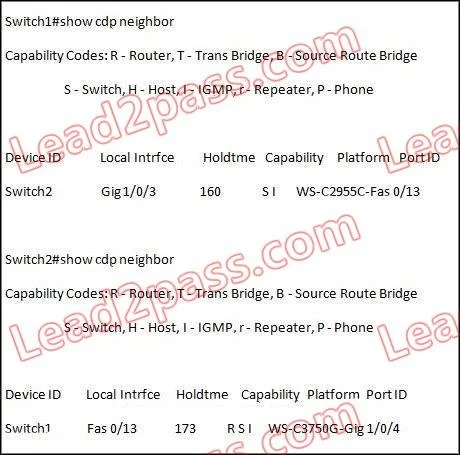
Options
- AUsers in SW1 can ping SW2 but not vice versa.
- BUsers in SW2 can ping SW1 but not vice versa.
- CUsers in SW1 and SW2 can ping each other.
- DUsers in SW1 and SW2 cannot ping each other.
How the community answered
(46 responses)- A4% (2)
- B15% (7)
- C4% (2)
- D76% (35)
Explanation
Without the visible exhibit, this question is testing a scenario where routing is misconfigured such that neither side can reach the other. The correct answer D (users in SW1 and SW2 cannot ping each other) indicates a complete bidirectional connectivity failure. Common causes for such a result shown in exhibit-based questions include: a routing misconfiguration where routes exist in one direction but not the other, creating an asymmetric black hole; incorrect subnet masks creating overlapping or non-routable subnets; or a missing or incorrect default gateway. Because neither A nor B (partial one-way connectivity) is correct, the failure is not asymmetric - it is a total failure preventing any ICMP exchange in either direction.
Topics
Community Discussion
No community discussion yet for this question.