
350-001 · Question #139
Which of these statements about PIM join messages in classic PIM-SM is correct?
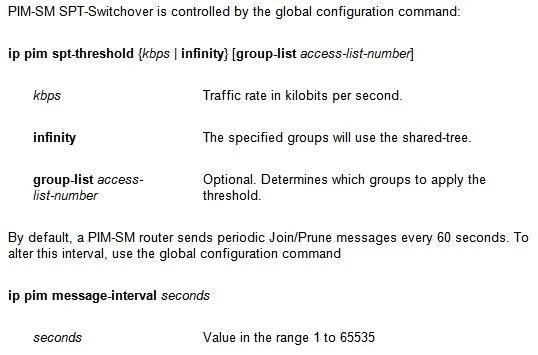
The correct answer is A. PIM join messages are sent every 60 seconds to refresh the upstream router's mroute state for. PIM Sparse Mode uses an explicit request approach, where a router has to ask for the multicast feed with a PIM Join message. PIM Sparse Mode is indicated when you need more precise control, especially when you have large volumes of IP multicast traffic compared to your…
Question
Which of these statements about PIM join messages in classic PIM-SM is correct?
Exhibit
Options
- APIM join messages are sent every 60 seconds to refresh the upstream router's mroute state for
- BRouters send a PIM join acknowledgement in response to each PIM join message received from a
- CPIM join messages are only sent when the multicast distribution tree is first being established.
- DPIM join messages are sent every three minutes to refresh the upstream router's mroute state for
How the community answered
(45 responses)- A93% (42)
- C4% (2)
- D2% (1)
Explanation
PIM Sparse Mode uses an explicit request approach, where a router has to ask for the multicast feed with a PIM Join message. PIM Sparse Mode is indicated when you need more precise control, especially when you have large volumes of IP multicast traffic compared to your bandwidth. PIM Sparse Mode scales rather well, because packets only go where they are needed, and because it creates state in routers only as needed. There can be different RP's for different multicast groups, which is one way to spread the load. There is usually one RP per multicast group. Redundancy of RP's is an advanced topic, and requires a little deeper expertise. One way to do this is with the MSDP protocol (possible later article in the series). PIM Join message is sent towards a Source (or for PIM-SM, possibly towards an RP), based on unicast routing. The Join message says in effect "we need a copy of the multicasts over here". It connects the sender of the Join and intervening routers to any existing multicast tree, all the way back to the target of the Join if necessary. A Prune message says in effect "we no longer need this over here". A router receiving a Prune sees whether it has any other interfaces requiring the multicast flow, and if not, sends its own Prune message. One advanced technique is to arrange a separate and perhaps different copy of the unicast routing information just for multicast purposes. This allows "steering" of the Join messages. Multiprotocol BGP, MBGP, for multicast, is one way to do this All PIM-SM-enabled routers should be configured with the same message interval time. A router will be pruned from a group if a Join message is not received in the message interval. The default value is three minutes.
Topics
Community Discussion
No community discussion yet for this question.