
300-915 · Question #45
Drag and Drop Question Drag and drop the tasks from the left into the correct order on the right for transporting data from sensors to the cloud, in order to extract the machine data and use the…
The correct answer is Develop a dashboard for data consumption based on business needs.; Interface the machine sensors using OPC based middleware.; Extract information from OPC using custom drivers or DSlink.; Remove duplicates and send filtered data to cloud.; Process real time critical alerts for immediate action. The question requires ordering tasks for an IoT data pipeline from sensor to cloud analytics, emphasizing the project lifecycle from defining business needs to real-time action and long-term visualization.
Question
Drag and Drop Question Drag and drop the tasks from the left into the correct order on the right for transporting data from sensors to the cloud, in order to extract the machine data and use the cloud-based analytics for predictive maintenance. Answer:
Exhibit
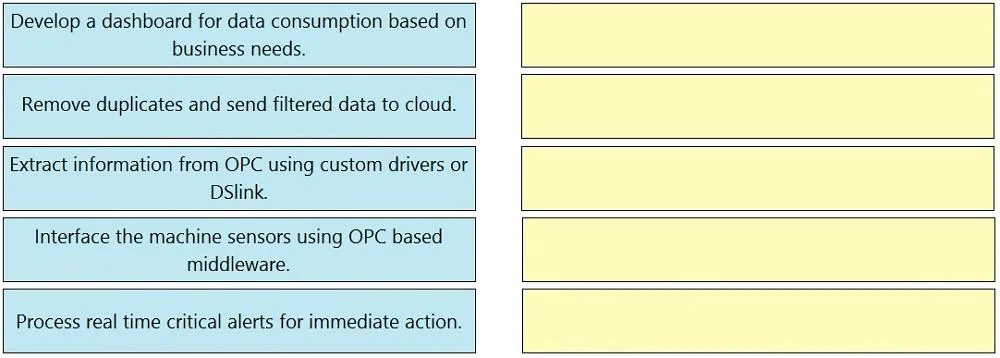
Answer Area
Drag items
Correct arrangement
- Develop a dashboard for data consumption based on business needs.
- Interface the machine sensors using OPC based middleware.
- Extract information from OPC using custom drivers or DSlink.
- Remove duplicates and send filtered data to cloud.
- Process real time critical alerts for immediate action.
Explanation
The question requires ordering tasks for an IoT data pipeline from sensor to cloud analytics, emphasizing the project lifecycle from defining business needs to real-time action and long-term visualization.
Approach. The correct interaction is to drag and drop the tasks into the following sequence, which represents a logical project lifecycle from requirement definition to data processing and consumption:
-
Develop a dashboard for data consumption based on business needs. This is the foundational step. Before building any data pipeline, it's crucial to understand the business requirements and how the data will be consumed and visualized (e.g., for predictive maintenance insights). Defining the dashboard's purpose sets the objectives for the entire data acquisition and processing effort.
-
Interlace the machine sensors using OPC based middleware. Once the data consumption requirements are understood, the next logical step is to establish the physical/logical connection to the data sources (sensors) using appropriate industrial communication protocols like OPC.
-
Extract information from OPC using custom drivers or DSLink. After successfully interfacing with the sensors via middleware, the actual data needs to be extracted from these sources. This involves specific drivers or tools to pull the raw information.
-
Remove duplicates and send filtered data to cloud. Following extraction, data often needs preprocessing (like filtering and de-duplication) at the edge before being efficiently transported to the cloud. This step ensures clean, relevant data is sent for cloud-based analytics.
-
Process real time critical alerts for immediate action. Once data is being transported to and processed in the cloud (or at the edge after filtering), a key use case is to implement real-time analytics to detect critical events and trigger immediate actions. This is a direct operational use of the processed data, complementing the longer-term predictive maintenance insights provided by dashboards.
Common mistakes.
- common_mistake. A common mistake is to assume a strict 'data flow' ordering and place 'Develop a dashboard for data consumption based on business needs' as one of the last steps. While the actual implementation of a dashboard comes later, the definition and design of what the dashboard should show (based on business needs) is a crucial initial step that guides the entire data pipeline development. Incorrectly ordering the data acquisition steps (e.g., extracting data before interfacing sensors, or sending to cloud before filtering) would also be technically illogical. Placing 'Process real time critical alerts' too early (before data is extracted and sent) would also be incorrect, as these alerts require processed data.
Concept tested. End-to-end understanding of an Industrial IoT (IIoT) or IoT solution lifecycle, encompassing requirements gathering, data acquisition (interfacing and extraction), edge processing, data transport to cloud, and various forms of data consumption (real-time alerts vs. historical dashboards for predictive maintenance). It tests knowledge of common IIoT components like OPC middleware.
Topics
Community Discussion
No community discussion yet for this question.