
300-820 · Question #64
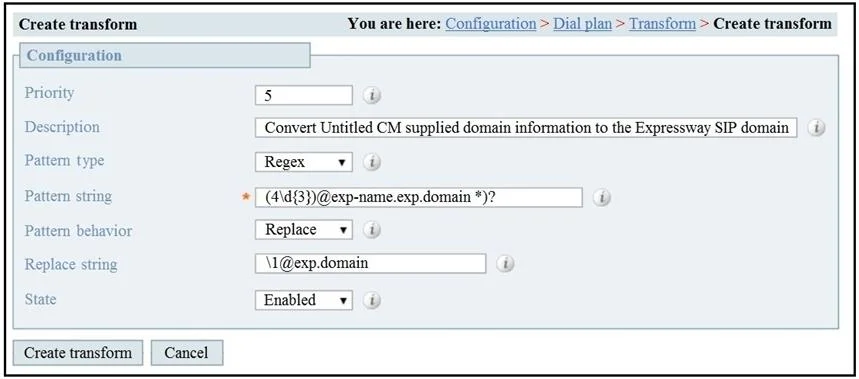
Refer to the exhibit. Which description of the transformation is true?
The correct answer is A. It converts [email protected]:<port> to [email protected]. This transformation rule on Cisco Expressway uses a regex-based pattern match and substitution. The pattern matches the full URI [email protected]:<port> - including the specific alias '4123', the full internal hostname 'exp-name.exp.domain', and the port number. The…
Question
Refer to the exhibit. Which description of the transformation is true?
Exhibit
Options
- AIt converts [email protected]:<port> to [email protected]
- BIt changes all patterns that begin with [email protected]:<port> to [email protected]
- CIt changes [email protected]:<port> to [email protected]
- DIt converts [email protected]:<port> to [email protected]
How the community answered
(69 responses)- A84% (58)
- B9% (6)
- C4% (3)
- D3% (2)
Explanation
This transformation rule on Cisco Expressway uses a regex-based pattern match and substitution. The pattern matches the full URI [email protected]:<port> - including the specific alias '4123', the full internal hostname 'exp-name.exp.domain', and the port number. The replacement strips the internal hostname and port, outputting [email protected] - preserving the numeric alias but simplifying the domain to just the base domain. This is a common transformation used to normalize internal FQDNs and port numbers into clean, routable external SIP URIs. Choice B is incorrect because the alias portion (4123) is preserved, not replaced with '1'. Choice C references '413' which does not match the pattern. Choice D references '4.3' (dot-wildcard notation) which would match differently and also incorrectly states the output alias as '1'.
Topics
Community Discussion
No community discussion yet for this question.