
300-820 · Question #175
Refer to the exhibit. An engineer must configure a B2B traversal zone. Trusted certification authority and server certificates are uploaded to Cisco Expressway-C and Expressway-E servers. After the…
The correct answer is B. The peer 1 address in Expressway-C is not the FADN of Expressway-E. E. The traversal zone TLS verify subject name in Expressway-E does not match the FQDN of. A B2B traversal zone TLS failure on Expressway-C is caused by specifying the wrong peer address and a mismatched TLS verify subject name, both of which prevent successful mutual TLS verification.
Question
Refer to the exhibit. An engineer must configure a B2B traversal zone. Trusted certification authority and server certificates are uploaded to Cisco Expressway-C and Expressway-E servers. After the traversal zone configuration is completed in Expressway-C, the error message in the exhibit appears. What are the two reasons for the error? (Choose two.)
Exhibit
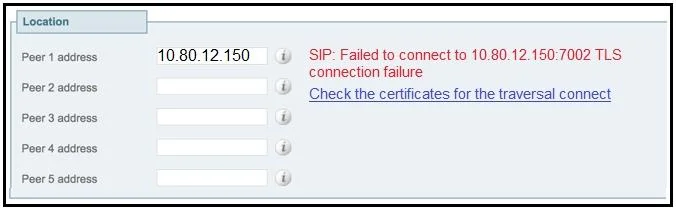
Options
- AThe peer 1 address in Expressway-C must be replaced by the FQDN of Expressway-C.
- BThe peer 1 address in Expressway-C is not the FADN of Expressway-E.
- CThe communication port is not set to 7001.
- DThe FQDN of Expressway-E cannot be resolved by the DNS server.
- EThe traversal zone TLS verify subject name in Expressway-E does not match the FQDN of
How the community answered
(53 responses)- A4% (2)
- B85% (45)
- C2% (1)
- D9% (5)
Why each option
A B2B traversal zone TLS failure on Expressway-C is caused by specifying the wrong peer address and a mismatched TLS verify subject name, both of which prevent successful mutual TLS verification.
The peer 1 address should reference Expressway-E, not Expressway-C; pointing it back to itself would create a loop and is not the correct fix.
The peer 1 address in Expressway-C must be the FQDN of Expressway-E so that TLS certificate verification can succeed; using an IP address or incorrect FQDN causes the TLS handshake to fail because the certificate CN or SAN will not match.
The default traversal zone port between Expressway-C and Expressway-E is 7001 for H.323 but TLS SIP traversal uses port 7443; the port is not the cause of this specific TLS error.
A DNS resolution failure would produce a different error indicating the host cannot be reached, not the TLS certificate mismatch error shown in the exhibit.
The TLS verify subject name configured on Expressway-E must match the FQDN presented in the Expressway-C certificate; a mismatch causes the traversal zone to reject the connection during mutual TLS negotiation.
Concept tested: Expressway B2B traversal zone TLS certificate configuration
Source: https://www.cisco.com/c/en/us/support/docs/unified-communications/expressway/200270-Configure-B2B-Calling-on-Expressway.html
Topics
Community Discussion
No community discussion yet for this question.