
300-810 · Question #182
Refer to the exhibit. Cisco UCM is integrated with Cisco Unity connection via a SIP truck and is configured using a globalized dial plan (directory number are configured with "*"). Using cisco best…
The correct answer is A. remove PSTN-PT from voicemail_CSS. In a globalized dial plan, removing the PSTN partition from the voicemail CSS prevents Unity Connection from transferring calls to PSTN numbers while still allowing transfers to internal directory numbers.
Question
Refer to the exhibit. Cisco UCM is integrated with Cisco Unity connection via a SIP truck and is configured using a globalized dial plan (directory number are configured with "*"). Using cisco best practices, which implementation allows call transfers to internal directory numbers but not to PSTN numbers?
Exhibit
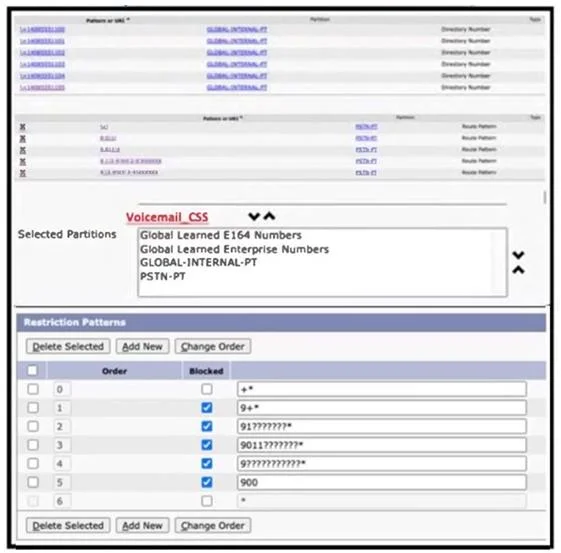
Options
- Aremove PSTN-PT from voicemail_CSS
- Bchange the order of partitions to put GLOBAL-INERNAL-PT first in Voicemail_CSS
- Ccreate a BLOCK-PSTN-PT partition and add it to Voicemail_CSS
- Dblock pattern +* in the Cisco Unity restriction table
How the community answered
(26 responses)- A73% (19)
- B8% (2)
- C15% (4)
- D4% (1)
Why each option
In a globalized dial plan, removing the PSTN partition from the voicemail CSS prevents Unity Connection from transferring calls to PSTN numbers while still allowing transfers to internal directory numbers.
With a globalized dial plan where directory numbers use the '+' prefix, internal numbers and PSTN numbers are differentiated by their respective route partitions. The voicemail CSS (Voicemail_CSS) must contain the internal partition to reach extensions but should not contain the PSTN partition. Removing PSTN-PT from Voicemail_CSS means Unity Connection can resolve internal +E.164 directory numbers but cannot route calls to PSTN destinations, directly enforcing the requirement.
Changing partition order within the CSS affects which match is found first when patterns overlap, but with a globalized dial plan the internal and PSTN patterns are distinct enough that reordering does not block PSTN access.
Creating a BLOCK-PSTN-PT partition with blocking patterns adds complexity and is not the Cisco best-practice approach; simply removing the PSTN partition from the CSS achieves the same result more cleanly.
Blocking '+*' in the Unity Connection restriction table would block all globalized dial plan numbers including internal ones, because internal directory numbers also use the '+' prefix in a globalized plan.
Concept tested: Cisco Unity Connection voicemail CSS globalized dial plan PSTN restriction
Source: https://www.cisco.com/c/en/us/td/docs/voice_ip_comm/cucm/srnd/collab12/collab12/dialplan.html
Topics
Community Discussion
No community discussion yet for this question.