
300-810 · Question #173
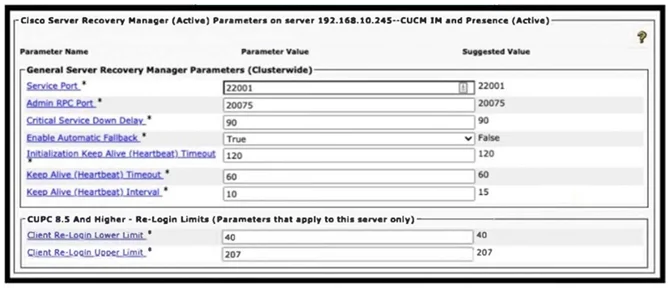
Refer to the exhibit. A collaboration engineer restored a failed primary node of an active/standby IM and presence subcluster. The engineer notices that users fallback to the node occurred. Which…
The correct answer is B. Wait for the primary node to establish 30 minutes of uptime. Cisco IM and Presence High Availability uses an automatic fallback mechanism. After a primary node recovers from a failure, the system deliberately waits until the restored node has demonstrated 30 minutes of continuous, stable uptime before automatically moving users back…
Question
Refer to the exhibit. A collaboration engineer restored a failed primary node of an active/standby IM and presence subcluster. The engineer notices that users fallback to the node occurred. Which action resolves this issue?
Exhibit
Options
- AReboot the primary node
- BWait for the primary node to establish 30 minutes of uptime
- CModify the Client Re-Login Limits
- DSet the Keep-Alive (Heartbeat) interval to 15.
How the community answered
(34 responses)- A3% (1)
- B82% (28)
- C3% (1)
- D12% (4)
Explanation
Cisco IM and Presence High Availability uses an automatic fallback mechanism. After a primary node recovers from a failure, the system deliberately waits until the restored node has demonstrated 30 minutes of continuous, stable uptime before automatically moving users back. This prevents rapid oscillation (flapping) between nodes if the primary node is unstable. The 30-minute stabilization timer is by design and is not configurable to a shorter period. Rebooting the primary node resets the timer. Modifying Client Re-Login Limits or Keep-Alive intervals are unrelated to the fallback trigger condition.
Topics
Community Discussion
No community discussion yet for this question.