
300-810 · Question #161
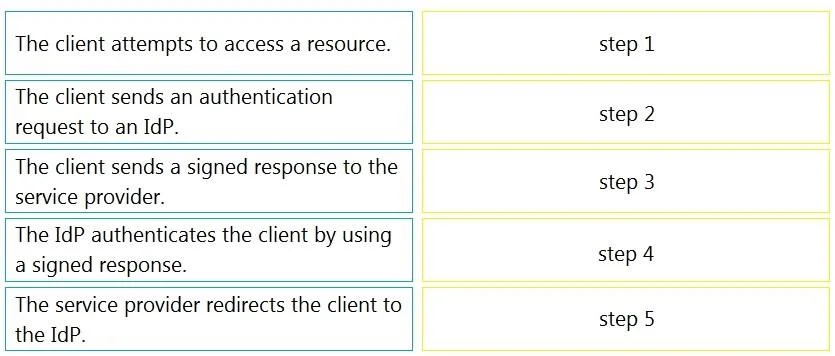
Drag and Drop Question Drag and drop the steps for SAML SSO authentication from the left into the order on the right. Answer:
The correct answer is The client attempts to access a resource.; The client sends an authentication request to an IdP.; The service provider redirects the client to the IdP.; The IdP authenticates the client by using a signed response.; The client sends a signed response to the service provider. This question tests the understanding of the sequential steps involved in a Service Provider (SP) initiated SAML Single Sign-On (SSO) authentication flow.
Question
Drag and Drop Question Drag and drop the steps for SAML SSO authentication from the left into the order on the right. Answer:
Exhibit
Answer Area
Drag items
Correct arrangement
- The client attempts to access a resource.
- The client sends an authentication request to an IdP.
- The service provider redirects the client to the IdP.
- The IdP authenticates the client by using a signed response.
- The client sends a signed response to the service provider.
Explanation
This question tests the understanding of the sequential steps involved in a Service Provider (SP) initiated SAML Single Sign-On (SSO) authentication flow.
Approach. The correct order for a Service Provider initiated SAML SSO authentication flow is as follows:
- The client attempts to access a resource. - This is the very first step, where a user (client) tries to access an application or resource that is protected by SSO.
- The service provider redirects the client to the IdP. - The Service Provider (SP) detects that the client is unauthenticated for the requested resource and redirects the client's browser to the Identity Provider (IdP) to initiate the authentication process.
- The client sends an authentication request to an IdP. - After being redirected, the client's browser interacts with the IdP, often sending a SAML authentication request to the IdP to begin the actual identity verification.
- The IdP authenticates the client by using a signed response. - The IdP receives the authentication request. It then prompts the user for credentials (if necessary) and performs the authentication. Upon successful authentication, the IdP generates a SAML assertion, which is a 'signed response' containing the user's identity information, ready to be sent back to the SP. While the phrasing 'by using a signed response' is slightly ambiguous, in this context, it refers to the IdP's process of authenticating the client and preparing the signed SAML assertion.
- The client sends a signed response to the service provider. - The IdP delivers the signed SAML assertion (the 'signed response') back to the client's browser. The client's browser then sends (typically 'posts') this assertion to the Service Provider's Assertion Consumer Service (ACS) endpoint. The SP then validates this assertion and grants the client access to the requested resource.
Common mistakes.
- common_mistake. Common mistakes include misunderstanding the roles and sequence of interactions between the client, Service Provider (SP), and Identity Provider (IdP). For instance, placing 'The client sends a signed response to the service provider' before 'The IdP authenticates the client...' would be incorrect, as the IdP must first authenticate the client and generate the response. Similarly, misplacing 'The service provider redirects the client to the IdP' would disrupt the initial SP-initiated flow where the SP acts as the gatekeeper. Another error might be to place 'The client sends an authentication request to an IdP' before the SP has redirected the client, which typically happens in an SP-initiated flow.
Concept tested. SAML (Security Assertion Markup Language) Single Sign-On (SSO) authentication flow, specifically the Service Provider initiated flow, detailing the interactions between the client (browser), Service Provider (SP), and Identity Provider (IdP).
Topics
Community Discussion
No community discussion yet for this question.