
300-810 · Question #141
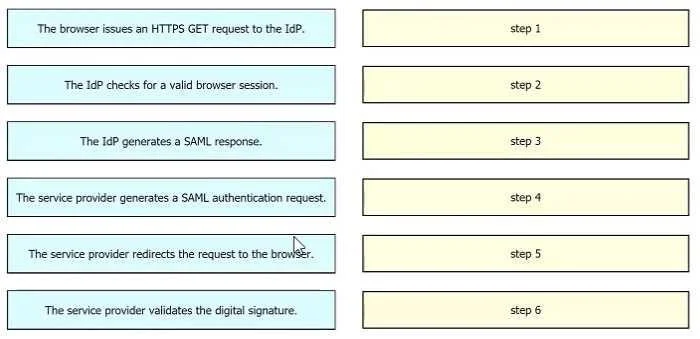
Drag and Drop Question Drag and drop the steps of the SAML SSO process from the left into the order on the right. Answer:
The correct answer is The service provider generates a SAML authentication request.; The service provider redirects the request to the browser.; The browser issues an HTTPS-GET request to the IdP.; The IdP checks for a valid browser session.; The IdP generates a SAML response.; The service provider validates the digital signature. The question tests the understanding of the Security Assertion Markup Language (SAML) Single Sign-On (SSO) process, specifically the Service Provider-initiated flow.
Question
Drag and Drop Question Drag and drop the steps of the SAML SSO process from the left into the order on the right. Answer:
Exhibit
Answer Area
Drag items
Correct arrangement
- The service provider generates a SAML authentication request.
- The service provider redirects the request to the browser.
- The browser issues an HTTPS-GET request to the IdP.
- The IdP checks for a valid browser session.
- The IdP generates a SAML response.
- The service provider validates the digital signature.
Explanation
The question tests the understanding of the Security Assertion Markup Language (SAML) Single Sign-On (SSO) process, specifically the Service Provider-initiated flow.
Approach. The correct interaction is to drag the steps from the left column into the right column's numbered slots in the following sequence, which represents a standard Service Provider-initiated SAML SSO flow:
- Step 1: The service provider generates a SAML authentication request. - When a user attempts to access a protected resource on the Service Provider (SP) and is not authenticated, the SP initiates the process by creating a SAML authentication request.
- Step 2: The service provider redirects the request to the browser. - The SP then sends this SAML authentication request back to the user's browser, typically via an HTTP 302 redirect, instructing the browser to forward it to the Identity Provider (IdP).
- Step 3: The browser issues an HTTPS GET request to the IdP. - The browser, following the SP's redirect, sends the SAML authentication request to the IdP's Single Sign-On URL. This request can be a GET (for small requests) or POST.
- Step 4: The IdP checks for a valid browser session. - Upon receiving the request, the IdP first checks if the user already has an active session (is authenticated). If not, it prompts the user for credentials. If yes (or after successful authentication), it proceeds to generate a response.
- Step 5: The IdP generates a SAML response. - After authenticating the user and verifying the request, the IdP constructs a SAML response containing an assertion about the user's identity and authentication status.
- Step 6: The service provider validates the digital signature. - The IdP sends the SAML response back to the user's browser, which then posts it to the SP's Assertion Consumer Service (ACS) URL. The SP receives this response and, as a critical security measure, validates the digital signature of the SAML response to ensure its authenticity and integrity before granting the user access to the requested resource.
Common mistakes.
- common_mistake. A common mistake is to missequence the actions between the browser, IdP, and SP. For example, placing 'The browser issues an HTTPS GET request to the IdP' before 'The service provider redirects the request to the browser' would be incorrect, as the browser needs to receive the authentication request from the SP first. Another error would be to place 'The IdP generates a SAML response' before 'The IdP checks for a valid browser session', as the IdP must authenticate the user or verify an existing session before creating an authentication assertion. Similarly, validating the digital signature is the final step for the SP to process the assertion, so placing it earlier in the flow, before the IdP has even generated a response, would be fundamentally wrong. Confusing IdP-initiated vs. SP-initiated flows could also lead to incorrect sequencing.
Concept tested. Security Assertion Markup Language (SAML) Single Sign-On (SSO) process, specifically the Service Provider-initiated flow, including the roles of the Service Provider, Identity Provider, and the user's browser. It tests the understanding of the message exchange and cryptographic steps involved in federated authentication.
Topics
Community Discussion
No community discussion yet for this question.