
300-810 · Question #151
A customer is using Cisco Unified IM and Presence with high availability and has reported that their primary node is not providing any IM and Presence services. What is causing this issue?
The correct answer is A. The presence redundancy group node state of the primary node is "idle". In Cisco Unified IM and Presence High Availability, each node in a Presence Redundancy Group has a defined state. The 'idle' state means the node is not actively providing IM and Presence services - it is essentially sitting out of service delivery. This is the direct cause of…
Question
A customer is using Cisco Unified IM and Presence with high availability and has reported that their primary node is not providing any IM and Presence services. What is causing this issue?
Exhibit
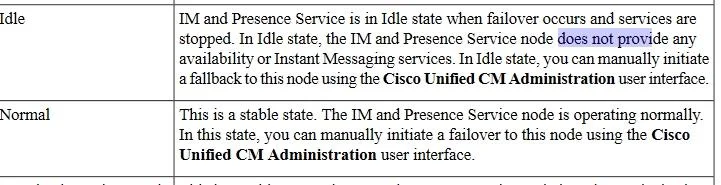
Options
- AThe presence redundancy group node state of the primary node is "idle".
- BThe presence redundancy group node state of the peer node is "normal".
- CThe presence redundancy group node state of the primary node is "initializing".
- DThe presence redundancy group node state of the peer node is "running in backup mode".
How the community answered
(34 responses)- A94% (32)
- B3% (1)
- C3% (1)
Explanation
In Cisco Unified IM and Presence High Availability, each node in a Presence Redundancy Group has a defined state. The 'idle' state means the node is not actively providing IM and Presence services - it is essentially sitting out of service delivery. This is the direct cause of the symptom described. In contrast, 'normal' means the node is healthy and serving users, 'initializing' means it is starting up, and 'running in backup mode' (choice D) describes the peer/secondary node that has taken over when the primary fails. None of those states would explain a primary that simply isn't serving users.
Topics
Community Discussion
No community discussion yet for this question.