
300-715 · Question #64
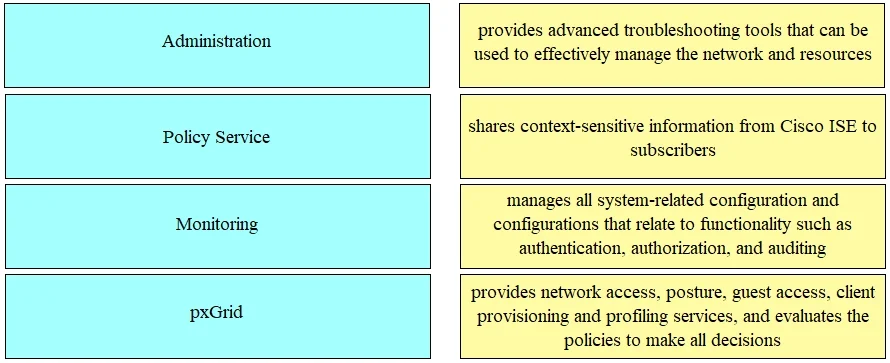
Drag and Drop Question Drag the Cisco ISE node types from the left onto the appropriate purposes on the right. Answer:
The correct answer is Monitoring; pxGrid; Administration; Policy Service. This drag-and-drop question requires matching Cisco ISE node types to their correct functional purposes within a distributed deployment.
Question
Exhibit
Answer Area
Drag items
Correct arrangement
- Monitoring
- pxGrid
- Administration
- Policy Service
Explanation
This drag-and-drop question requires matching Cisco ISE node types to their correct functional purposes within a distributed deployment.
Approach. The correct approach is to drag each Cisco ISE node type from the left column in the second image to its corresponding purpose description in the right column of the second image. The correct pairings are as follows:
- Drag 'Administration' (from the left blue box) to 'manages all system-related configuration and configurations that relate to functionality such as authentication, authorization, and auditing' (the yellow box on the right). The Administration Node (PAN) is responsible for all configuration, user management, and overall system administration.
- Drag 'Policy Service' (from the left blue box) to 'provides network access, posture, guest access, client provisioning and profiling services, and evaluates the policies to make all decisions' (the yellow box on the right). The Policy Service Node (PSN) is the primary contact point for network access devices and handles all policy enforcement, authentication, and authorization.
- Drag 'Monitoring' (from the left blue box) to 'provides advanced troubleshooting tools that can be used to effectively manage the network and resources' (the yellow box on the right). The Monitoring Node (MNT) collects and stores all operational data, including logs, alarms, and audit information, which is crucial for troubleshooting and reporting.
- Drag 'pxGrid' (from the left blue box) to 'shares context-sensitive information from Cisco ISE to subscribers' (the yellow box on the right). The pxGrid (Platform Exchange Grid) service enables Cisco ISE to share contextual information with other security products and subscribers, facilitating integration and automated responses.
Common mistakes.
- common_mistake. A common mistake would be to confuse the roles of the different ISE nodes, especially the Policy Service Node (PSN) with the Administration Node (PAN) or the Monitoring Node (MNT). For example, incorrectly dragging 'Administration' to the description of network access and policy evaluation (which is the PSN's role) would be wrong because the PAN focuses on management and configuration, not direct policy enforcement or network access services. Similarly, confusing 'Monitoring' with 'Administration' is incorrect; while both are management plane functions, Monitoring specifically handles logging, reporting, and troubleshooting data, whereas Administration handles active configuration and control.
Concept tested. The underlying technical concept being tested is the understanding of Cisco Identity Services Engine (ISE) distributed deployment architecture and the distinct functional roles of its core node types: Administration Node (PAN), Policy Service Node (PSN), Monitoring Node (MNT), and the pxGrid service.
Topics
Community Discussion
No community discussion yet for this question.