
300-625 · Question #25
Drag and Drop Question Drag and drop the FLOGI parameters from the left onto the descriptions from which they were- derived on the right. Answer:
The correct answer is nWWN; IP address; fWWN; symbolic node name; pWWN. FLOGI Parameters: Explanation FLOGI (Fabric Login) is the process by which an N_Port (host/storage HBA) registers with a Fibre Channel fabric to receive fabric services and a Fibre Channel address (FCID). > Note: The right-side descriptions are not shown in your question, so…
Question
Drag and Drop Question Drag and drop the FLOGI parameters from the left onto the descriptions from which they were- derived on the right. Answer:
Exhibit
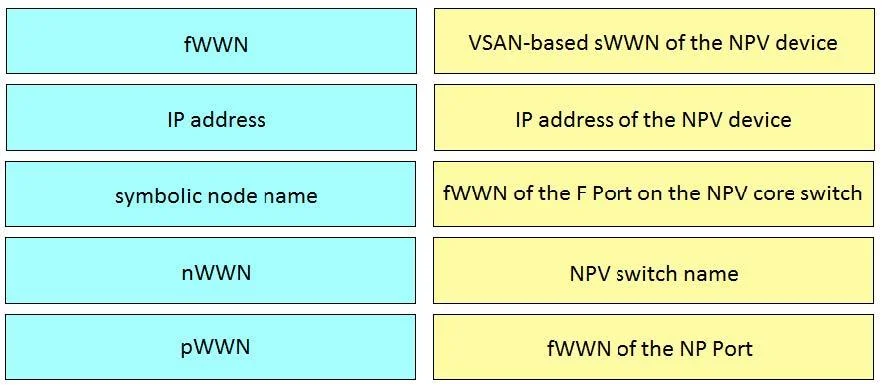
Answer Area
Drag items
Correct arrangement
- nWWN
- IP address
- fWWN
- symbolic node name
- pWWN
Explanation
FLOGI Parameters: Explanation
FLOGI (Fabric Login) is the process by which an N_Port (host/storage HBA) registers with a Fibre Channel fabric to receive fabric services and a Fibre Channel address (FCID).
Note: The right-side descriptions are not shown in your question, so the explanation below covers the standard technical derivation for each parameter's placement.
Parameter Placements Explained
1. nWWN (Node World Wide Name)
- What it is: A globally unique 64-bit identifier for the entire HBA node (the adapter card itself), not a specific port.
- Derived from: The HBA manufacturer's burned-in node identifier (OUI + vendor-assigned value), formatted as an NAA (Name Authority) identifier.
- Key point: One nWWN per physical adapter, shared across all ports on that adapter.
2. IP address
- What it is: A Layer 3 network address - relevant in FCoE (Fibre Channel over Ethernet) environments.
- Derived from: The management or data network configuration (DHCP or static), not from the FC fabric itself.
- Key point: IP addressing is an FCoE/iSCSI concern, not native FC - this is a common misconception area.
3. fWWN (Fabric Port World Wide Name)
- What it is: The WWN of the F_Port (fabric switch port) that accepts the FLOGI.
- Derived from: The fabric switch itself - assigned to the switch port, not the host.
- Key point: The f stands for Fabric. Students often confuse fWWN with pWWN - fWWN belongs to the switch side, pWWN belongs to the host side.
4. Symbolic Node Name
- What it is: A human-readable ASCII string that identifies the node in the fabric name server.
- Derived from: Host software/OS configuration - typically the hostname or a manually set string.
- Key point: This is optional and configurable; it has no hardware basis and is not globally enforced for uniqueness.
5. pWWN (Port World Wide Name)
- What it is: A globally unique 64-bit identifier for a specific port on an HBA.
- Derived from: The HBA port's burned-in address (OUI + port-specific vendor value). In FCoE, it can be derived algorithmically from the MAC address.
- Key point: A dual-port HBA has one nWWN but two pWWNs. This is the most commonly tested distinction.
Common Mistakes
| Mistake | Clarification |
|---|---|
| Confusing nWWN and pWWN | nWWN = the node/adapter; pWWN = a specific port on that adapter |
| Thinking fWWN belongs to the host | fWWN is the switch's fabric port WWN |
| Treating symbolic node name as hardware-derived | It is software-configured, not hardware-burned |
| Placing IP address in a native FC context | IP address is only relevant in FCoE/IP-based SAN environments |
The core principle: WWNs are hardware-derived (burned-in OUI), symbolic names are software-configured, IP addresses come from network config, and fWWN comes from the fabric/switch - not the initiator.
Topics
Community Discussion
No community discussion yet for this question.