
300-625 · Question #24
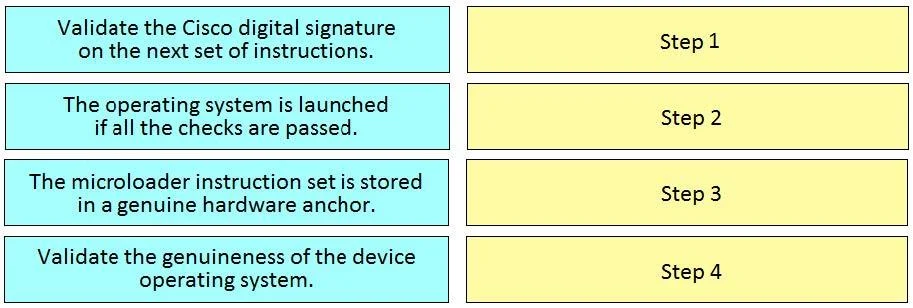
Drag and Drop Question Drag and drop the mechanisms of Cisco Secure Boot from the left into the correct order on the right. Answer:
The correct answer is The microloader instruction set is stored in a genuine hardware anchor.; Validate the Cisco digital signature on the next set of instructions.; Validate the genuineness of the device operating system.; The operating system is launched if all the checks are passed. Cisco Secure Boot - Chain of Trust Explained Cisco Secure Boot implements a hardware-rooted chain of trust. Each step must succeed before the next can begin. Think of it as a series of locked doors where each door can only be opened by the key proven in the previous step…
Question
Drag and Drop Question Drag and drop the mechanisms of Cisco Secure Boot from the left into the correct order on the right. Answer:
Exhibit
Answer Area
Drag items
Correct arrangement
- The microloader instruction set is stored in a genuine hardware anchor.
- Validate the Cisco digital signature on the next set of instructions.
- Validate the genuineness of the device operating system.
- The operating system is launched if all the checks are passed.
Explanation
Cisco Secure Boot - Chain of Trust Explained
Cisco Secure Boot implements a hardware-rooted chain of trust. Each step must succeed before the next can begin. Think of it as a series of locked doors where each door can only be opened by the key proven in the previous step.
Step-by-Step Breakdown
1. The microloader instruction set is stored in a genuine hardware anchor.
This is the Root of Trust (RoT). The microloader is the very first code executed at power-on and is burned directly into silicon (ROM) - it cannot be modified or replaced. Because it lives in immutable hardware, it serves as the unconditionally trusted starting point for the entire chain. Nothing in software can compromise it. This must be first because every subsequent check depends on having a trustworthy starting point.
2. Validate the Cisco digital signature on the next set of instructions.
Once the microloader runs from the hardware anchor, it validates that the next stage (typically the bootloader) carries a valid Cisco cryptographic signature. This ensures that only Cisco-authorized code is loaded into memory. If the signature fails, the boot halts here. This comes before OS validation because the bootloader itself must be trusted before it can be trusted to check anything else.
3. Validate the genuineness of the device operating system.
With a trusted bootloader in place, the chain now extends to the OS image. The bootloader checks that the OS hasn't been tampered with and is an authentic Cisco-signed image. This is separate from step 2 because the bootloader and OS are distinct code components, each requiring independent verification.
4. The operating system is launched if all the checks are passed.
The OS only launches after the entire chain has been verified. This is the payoff of secure boot - the running system is guaranteed to be authentic and unmodified. No OS code executes until every preceding check succeeds.
Common Mistakes
| Mistake | Why It's Wrong |
|---|---|
| Putting OS validation before the signature check | The bootloader must be verified before it can be trusted to verify the OS |
| Putting OS launch anywhere but last | Launching before all checks defeats the entire purpose of secure boot |
| Thinking the hardware anchor is optional or can come later | The chain of trust must start in hardware - a software-only starting point can itself be compromised |
| Conflating steps 2 and 3 as the same step | Bootloader and OS are separate code stages requiring separate verification |
Key Mental Model
Hardware (ROM) → Verify Bootloader Signature → Verify OS Signature → Launch OS
Each arrow represents a verification gate. A failure at any gate terminates the boot process, preventing compromised code from ever running.
Topics
Community Discussion
No community discussion yet for this question.