
300-620 · Question #6
Refer to the exhibit. Which Adjacency Type value should be set when the client endpoint and the service node interface are in a different subnet?
The correct answer is D. L3. When enabling routing, keep in mind that you must enable it in two places in the service graph: ● The bridge domain ● The graph connector Figure 20 illustrates this point. Figure 20. When Enabling Routing on a Bridge Domain, Make Sure That the Graph Template Connectors Are Set…
Question
Refer to the exhibit. Which Adjacency Type value should be set when the client endpoint and the service node interface are in a different subnet?
Exhibit
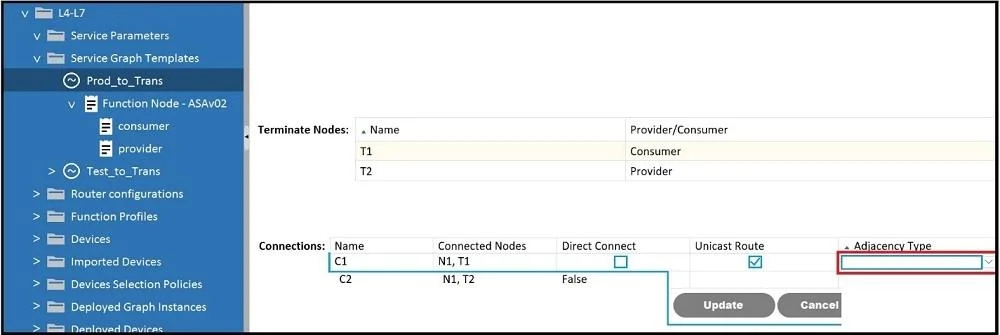
Options
- ARouted
- BUnicast
- CL3Out
- DL3
How the community answered
(27 responses)- A4% (1)
- D96% (26)
Explanation
When enabling routing, keep in mind that you must enable it in two places in the service graph: ● The bridge domain ● The graph connector Figure 20 illustrates this point. Figure 20. When Enabling Routing on a Bridge Domain, Make Sure That the Graph Template Connectors Are Set for Routing In general, these connectors are set to unicast routing by default. This setting makes the final state of the bridge domain dependent only on the routing configuration on the bridge domain. If the connector is associated with a bridge domain that provides the Layer 3 outside (L3Out) interface function, in addition to verifying that the unicast routing option is set to true, you need to make sure that the adjacency is set to Layer 3, not Layer 2, as in Figure 21. Figure 21. To Help Ensure That the Switch Virtual Interface Is Enabled on the Bridge Domain with L3Out, Set Adjacency to Layer 3 In summary, IP routing may be necessary in bridge domains that meet the following criteria: ● Bridge domains that provide routing to bridge domains that provide routing to another bridge domain or to the outside ● Bridge domains to which servers are connected, if you plan to use endpoint attachment infrastructure/white-paper-c11-734298.html
Topics
Community Discussion
No community discussion yet for this question.