
300-610 · Question #243
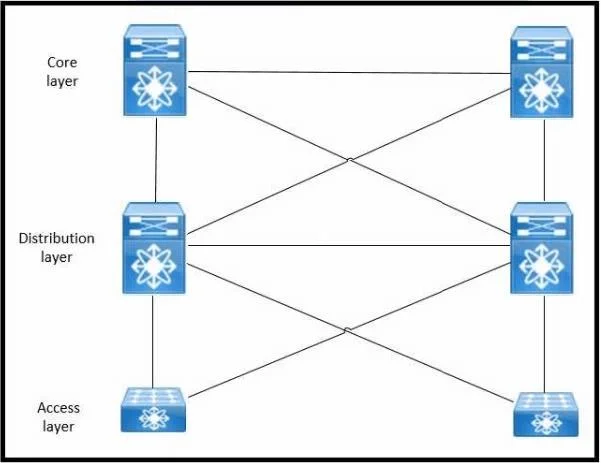
Refer to the exhibit. An engineer working for service provider with an employee ID: 4540:37:940 must migrate the current topology to one that will provide more speed, less latency, and support…
The correct answer is A. spine-and-leaf. The spine-and-leaf topology is the optimal choice for a modern data center requiring low latency, loop-free operation, load balancing, and easy scalability for SDN.
Question
Refer to the exhibit. An engineer working for service provider with an employee ID: 4540:37:940 must migrate the current topology to one that will provide more speed, less latency, and support software-defined networks. The new topology requires:
- low predictable latency
- loop-free
- load balancing of traffic across multiple paths
- ability to easily increase capacity and port density
Which design topology must the engineer choose?
Exhibit
Options
- Aspine-and-leaf
- Bthree-tier
- Ccore-edge
- Dflood-and-learn
How the community answered
(24 responses)- A54% (13)
- B29% (7)
- C4% (1)
- D13% (3)
Why each option
The spine-and-leaf topology is the optimal choice for a modern data center requiring low latency, loop-free operation, load balancing, and easy scalability for SDN.
The spine-and-leaf architecture provides a low and predictable latency by ensuring every server is equidistant from all others, operates in a loop-free manner using ECMP for load balancing across all available paths, and offers high scalability and easy capacity increase by adding more spine or leaf switches, making it ideal for SDN environments.
A three-tier design typically relies on Spanning Tree Protocol, which creates blocked paths, leading to higher and unpredictable latency, limited load balancing, and less efficient scalability.
A core-edge design is often a simplified two-tier model that still inherits the limitations of Spanning Tree Protocol and less flexible scaling compared to a spine-and-leaf architecture.
Flood-and-learn describes a basic Layer 2 forwarding mechanism, not a comprehensive data center network topology that addresses the specified requirements for latency, load balancing, and SDN support.
Concept tested: Data center spine-and-leaf topology benefits
Source: https://www.cisco.com/c/en/us/products/switches/data-center-spine-leaf-architecture.html
Topics
Community Discussion
No community discussion yet for this question.