
300-610 · Question #217
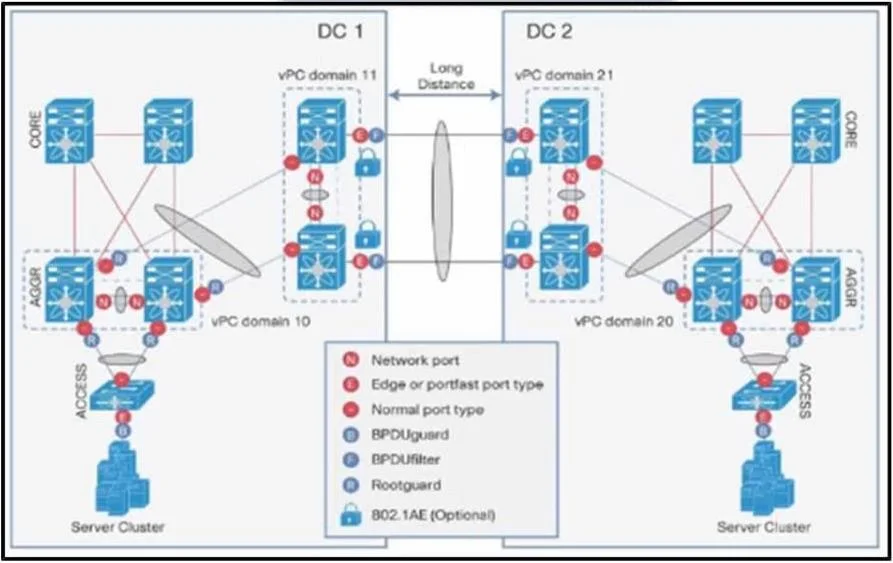
Refer to the exhibit. In this scenario a Cisco engineer is building a loop-free topology where a dedicated layer of the vPC domain adjacent to the aggregation layer which also runs vPC is used to…
The correct answer is A. Configure vPC-peer-keepalive link on both peer devices. To successfully form a vPC domain after globally configuring the same vPC domain identifier on both peer devices, configuring the vPC-peer-keepalive link is the crucial next step.
Question
Refer to the exhibit. In this scenario a Cisco engineer is building a loop-free topology where a dedicated layer of the vPC domain adjacent to the aggregation layer which also runs vPC is used to interconnect the two data centers together. The engineer globally configures a vPC domain identifier on both vPC devices where the domain ID is the same on both peer devices. Which action successfully forms the domain?
Exhibit
Options
- AConfigure vPC-peer-keepalive link on both peer devices
- BPut peer device interfaces into a suspended state.
- CEnable and reuse an ISL Layer 3 trunk port channel
- DSynchronize the MAC addresses for the member ports
How the community answered
(34 responses)- A94% (32)
- C3% (1)
- D3% (1)
Why each option
To successfully form a vPC domain after globally configuring the same vPC domain identifier on both peer devices, configuring the vPC-peer-keepalive link is the crucial next step.
The vPC-peer-keepalive link is essential for establishing and maintaining the vPC domain by providing a heartbeat between the two vPC peer devices. This link monitors the health of the peer and prevents a split-brain scenario if the vPC peer link fails, ensuring the domain forms and operates correctly.
Putting peer device interfaces into a suspended state would prevent the vPC domain from forming and passing traffic, as it isolates the interfaces.
An ISL Layer 3 trunk port channel is not a standard component for vPC domain formation; the vPC peer link is typically a Layer 2 port channel, and the keepalive is a Layer 3 link.
Synchronizing MAC addresses for member ports is a consequence of vPC working correctly, not an action that forms the domain itself.
Concept tested: Cisco vPC domain formation requirements
Source: https://www.cisco.com/c/en/us/products/collateral/switches/nexus-7000-series-switches/guide_c07-618821.html
Topics
Community Discussion
No community discussion yet for this question.