
300-610 · Question #242
Refer to the exhibit. A customer requires a VXLAN fabric deployment with these requirements: - DNS must be a shared service. - Users will not require direct sharing of resources with other users…
The correct answer is D. Encapsulate traffic on VTEP1 with VNI 5000. To provide shared DNS services and user isolation with minimal route leaking configuration, traffic on VTEP1, where the DNS server is connected, must be encapsulated with VNI 5000, which is associated with the 'shared' VRF.
Question
Refer to the exhibit. A customer requires a VXLAN fabric deployment with these requirements:
- DNS must be a shared service.
- Users will not require direct sharing of resources with other users.
- The deployment must use the least configuration intensive approach to
achieve route leaking. Which action must the customer take to meet these criteria?
Exhibit
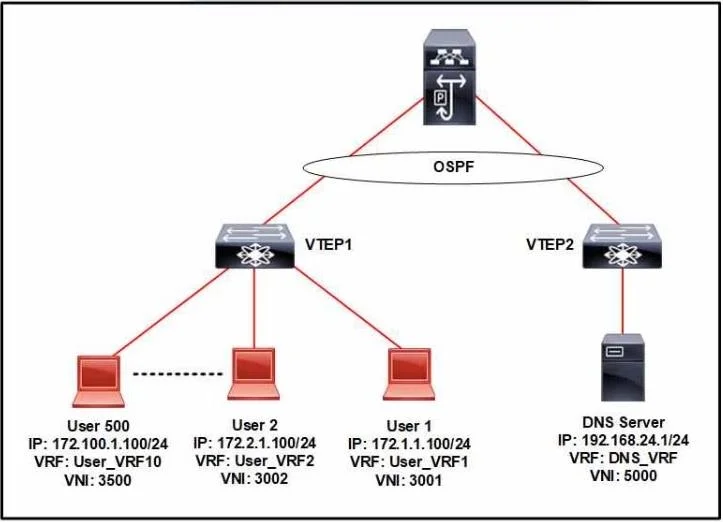
Options
- AEncapsulate traffic on VTEP2 with VNI 3002.
- BEncapsulate traffic on VTEP2 with VNI 5000.
- CEncapsulate traffic on VTEP1 with VNI 3002.
- DEncapsulate traffic on VTEP1 with VNI 5000.
How the community answered
(39 responses)- A5% (2)
- B8% (3)
- C3% (1)
- D85% (33)
Why each option
To provide shared DNS services and user isolation with minimal route leaking configuration, traffic on VTEP1, where the DNS server is connected, must be encapsulated with VNI 5000, which is associated with the 'shared' VRF.
VNI 3002 is associated with VRF Yellow, which is for isolated users and would not allow the DNS server to be a shared service.
The DNS server is connected to VTEP1, not VTEP2, so encapsulating DNS traffic on VTEP2 with VNI 5000 is incorrect.
VNI 3002 is for isolated users (VRF Yellow), not for shared services like DNS, which require a common VNI across tenants for route leaking.
VNI 5000 is assigned to the shared VRF, which is designed for shared services like DNS. Encapsulating traffic on VTEP1 with VNI 5000, where the DNS server is located, ensures the DNS service is accessible by all tenants while enabling the least configuration-intensive approach to route leaking for shared services.
Concept tested: VXLAN EVPN shared services and route leaking
Source: https://www.cisco.com/c/en/us/td/docs/dcn/aci/cisco_aci_multi-site_architectures/b_Cisco_ACI_Multi-Site_Architectures/b_Cisco_ACI_Multi-Site_Architectures_chapter_0100.html
Topics
Community Discussion
No community discussion yet for this question.