
300-610 · Question #214
Refer to the exhibit. A Cisco engineer is configuring a customer scenario with 2 x MDS 9000 switches 24 x UCS B200M6 blade servers. UCS 64S4 Fabric Interconnect in end-host mode and 3 x UCS 5108…
The correct answer is D. Disable restrictions on oversubscription ratios. When restrictions on oversubscription ratios are disabled, the bandwidth allocation among the shared ports is proportionate to the configured speed. (If the configured speed is auto, then bandwidth is allocated assuming a speed of 4 Gbps.) For example, if you have three shared…
Question
Refer to the exhibit. A Cisco engineer is configuring a customer scenario with 2 x MDS 9000 switches 24 x UCS B200M6 blade servers. UCS 64S4 Fabric Interconnect in end-host mode and 3 x UCS 5108 server chassis with 2408 Fabric Extenders. The engineer installs 6 x SQL Server 2019 on all blades and then notices that there are read and write latencies. What is the best way to balance the utilization across the shared ports?
Exhibit
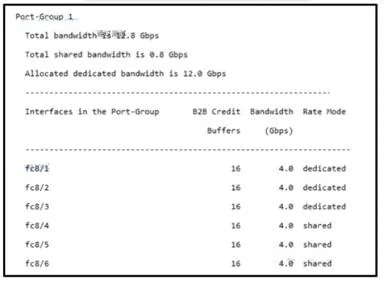
Options
- AEnable "Only dedicate rate mode
- BChange the assigned speed to 8 Gbps Auto.
- CSet 4 Gbps performance buffers
- DDisable restrictions on oversubscription ratios
How the community answered
(64 responses)- A9% (6)
- B5% (3)
- C3% (2)
- D83% (53)
Explanation
When restrictions on oversubscription ratios are disabled, the bandwidth allocation among the shared ports is proportionate to the configured speed. (If the configured speed is auto, then bandwidth is allocated assuming a speed of 4 Gbps.) For example, if you have three shared ports configured at 1, 2, and 4 Gbps, then the allocated bandwidth ratio is 1:2:4. In Cisco SAN-OS Release 3.0 and later (or when restrictions on oversubscription ratios are enabled), port bandwidths are allocated in equal proportions, regardless of port speed, so, the bandwidth allocation for the same three ports mentioned in the example would be 1:1:1. es/fm_3_2/gen2.html#wp1392649
Topics
Community Discussion
No community discussion yet for this question.