
300-610 · Question #213
Refer to the exhibit. A default route must be advertised into the VXLAN fabric for internet access. The engineer must use a static route because the edge firewall does not support any dynamic…
The correct answer is D. policy-based routing E. anycast gateway. To dynamically learn and withdraw a static default route for internet access in a VXLAN fabric, Policy-Based Routing (PBR) can be used for conditional route advertisement, while Anycast Gateway ensures optimal internal host routing.
Question
Refer to the exhibit. A default route must be advertised into the VXLAN fabric for internet access. The engineer must use a static route because the edge firewall does not support any dynamic routing protocol. Which two features must the engineer use to allow learning and withdrawing of the default route without any manual intervention? (Choose two)
Exhibit
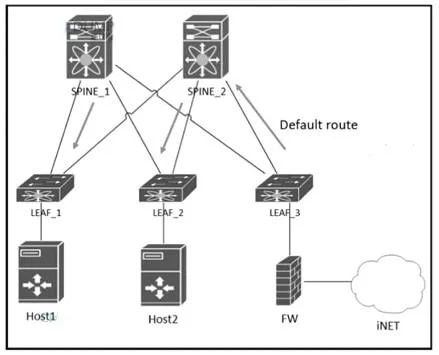
Options
- AIP forwarding
- BHMM tracking
- CNetwork Address Translation
- Dpolicy-based routing
- Eanycast gateway
How the community answered
(29 responses)- A3% (1)
- B7% (2)
- C14% (4)
- D76% (22)
Why each option
To dynamically learn and withdraw a static default route for internet access in a VXLAN fabric, Policy-Based Routing (PBR) can be used for conditional route advertisement, while Anycast Gateway ensures optimal internal host routing.
IP forwarding is a fundamental routing function but does not provide dynamic learning and withdrawing mechanisms for static routes.
HMM tracking (Host Mobility Manager tracking) is a feature used within VXLAN EVPN for tracking host MAC and IP address mobility, not for dynamic withdrawal of external static routes.
Network Address Translation (NAT) is used for IP address translation and does not facilitate the dynamic learning or withdrawal of routing information.
Policy-Based Routing (PBR) can be utilized at the border leaf to conditionally redistribute the static default route into BGP EVPN, often in conjunction with a tracking object (like IP SLA). This allows the default route to be advertised into the fabric only when the next-hop (the edge firewall) is reachable, and to be automatically withdrawn if the firewall becomes unavailable.
Anycast Gateway provides an active-active default gateway for internal hosts across multiple VTEPs within the VXLAN fabric. This ensures high availability and optimal routing for tenant traffic originating from the VXLAN segments and destined for the internet, utilizing the externally advertised default route.
Concept tested: VXLAN DCI static route dynamic withdrawal
Source: https://www.cisco.com/c/en/us/td/docs/switches/datacenter/nexus9000/sw/7-x/vxlan/configuration/guide/b_Cisco_Nexus_9000_Series_NX-OS_VXLAN_Configuration_Guide_7x/b_Cisco_Nexus_9000_Series_NX-OS_VXLAN_Configuration_Guide_7x_chapter_01000.html
Topics
Community Discussion
No community discussion yet for this question.