
300-540 · Question #70
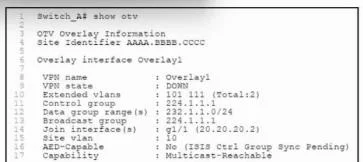
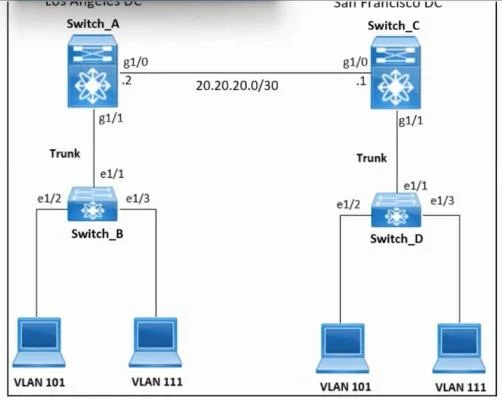
Refer to the exhibit. An engineer is troubleshooting an issue where Cisco switch Switch_A fails to establish OTV connectivity to Cisco switch Switch_C. What is the cause of the issue?
The correct answer is B. The join interface must be g1/0. In Cisco Overlay Transport Virtualization (OTV), the join interface is the Layer 3 interface that connects the edge device to the transport network (the routed core / WAN) where multicast groups (control, data, broadcast) are reachable. From the topology: Interface g1/0 on…
Question
Refer to the exhibit. An engineer is troubleshooting an issue where Cisco switch Switch_A fails to establish OTV connectivity to Cisco switch Switch_C. What is the cause of the issue?
Exhibits
Options
- AThe broadcast group must be 232.1.1.0.
- BThe join interface must be g1/0.
- CThe control group must be 232.1.1.0.
- DThe join interface must be e1/1.
How the community answered
(56 responses)- A16% (9)
- B70% (39)
- C5% (3)
- D9% (5)
Explanation
In Cisco Overlay Transport Virtualization (OTV), the join interface is the Layer 3 interface that connects the edge device to the transport network (the routed core / WAN) where multicast groups (control, data, broadcast) are reachable. From the topology: Interface g1/0 on Switch_A is connected to the routed 20.20.20.0/30 link toward Switch_C (the transport / WAN). Interface g1/1 is a trunk toward Switch_B and carries extended VLANs (101, 111), so it belongs to the internal site-facing side, not the transport. In the show otv output, the join interface is incorrectly configured as g1/1 (20.20.20.2), which is an internal trunk and not the correct routed interface to the OTV transport network. Because the join interface does not face the multicast-enabled transport, OTV cannot establish adjacency and the VPN state remains DOWN. Correct configuration should use: otv join-interface GigabitEthernet1/0
Topics
Community Discussion
No community discussion yet for this question.