
300-540 · Question #66
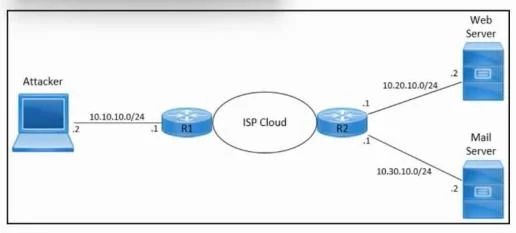
Refer to the exhibit. An engineer must stop a DoS attack on web and mail servers by using destination-based RTBH routing. Which two commands must be run on router R1? (Choose two)
The correct answer is A. ip route 10.30.10.2 255.255.255.255 null0 C. ip route 10.20.10.2 255.255.255.255 null0. Destination-based Remote Triggered Black Hole (RTBH) routing is a DDoS mitigation technique where traffic to a victim's IP address is intentionally routed to a special next hop (usually Null0) so that the traffic is dropped as close to the source as possible. On the edge router…
Question
Refer to the exhibit. An engineer must stop a DoS attack on web and mail servers by using destination-based RTBH routing. Which two commands must be run on router R1? (Choose two)
Exhibit
Options
- Aip route 10.30.10.2 255.255.255.255 null0
- Bno ip route 10.20.10.0 255.255.255.0 10.10.10.2
- Cip route 10.20.10.2 255.255.255.255 null0
- Dno ip route 10.30.10.0 255.255.255.0 10.10.10.2
- Eip route 10.20.10.1 255.255.255.255 null0
How the community answered
(31 responses)- A77% (24)
- B3% (1)
- D6% (2)
- E13% (4)
Explanation
Destination-based Remote Triggered Black Hole (RTBH) routing is a DDoS mitigation technique where traffic to a victim's IP address is intentionally routed to a special next hop (usually Null0) so that the traffic is dropped as close to the source as possible. On the edge router (R1 in the figure), this is accomplished by installing /32 static routes for the victim endpoints, pointing to the null interface. When these routes are installed (often triggered via BGP in larger deployments), any traffic destined to those exact IP addresses is discarded. In the topology: Web server IP: 10.20.10.2 Mail server IP: 10.30.10.2 To perform destination-based RTBH at R1, we must configure static /32 routes to Null0 for each ip route 10.20.10.2 255.255.255.255 Null0 ip route 10.30.10.2 255.255.255.255 Null0 These correspond to: Option C for the web server (10.20.10.2) Option A for the mail server (10.30.10.2)
Topics
Community Discussion
No community discussion yet for this question.