
300-540 · Question #65
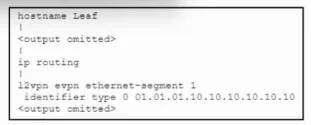
Refer to the exhibit. An engineer must configure dual-homing with single active redundancy in a BGP EVPN VXLAN fabric. Which command must be run on the leaf router to complete the EVPN Ethernet…
The correct answer is A. redundancy single-active. In a BGP EVPN VXLAN multi-homing design, Ethernet Segment Identifiers (ESIs) are used to represent a set of links from one or more leaf switches to the same downstream device (such as a CE, firewall, or aggregation switch). By default, when multiple leafs share the same ESI…
Question
Refer to the exhibit. An engineer must configure dual-homing with single active redundancy in a BGP EVPN VXLAN fabric. Which command must be run on the leaf router to complete the EVPN Ethernet segment configuration?
Exhibit
Options
- Aredundancy single-active
- Bdefault-gateway advertise
- Creplication-type static
- Dvlan configuration 101
How the community answered
(57 responses)- A82% (47)
- B11% (6)
- C4% (2)
- D4% (2)
Explanation
In a BGP EVPN VXLAN multi-homing design, Ethernet Segment Identifiers (ESIs) are used to represent a set of links from one or more leaf switches to the same downstream device (such as a CE, firewall, or aggregation switch). By default, when multiple leafs share the same ESI, the EVPN design supports all-active redundancy, where all participating leafs can forward traffic for that Ethernet segment simultaneously. However, some use cases--like connecting to devices that do not support multipath forwarding or for strict active/standby redundancy--require single-active multi-homing. In single-active mode, only one leaf in the Ethernet segment forwards traffic at any time; the other leaf(s) act as standby and only take over if the active node fails. This behavior is explicitly controlled in the EVPN Ethernet- segment configuration. On Cisco platforms for EVPN VXLAN fabrics, this is configured under the l2vpn evpn ethernet- segment stanza using the command: l2vpn evpn ethernet-segment 1 identifier type 0 01.01.01.10.10.10.10.10.10.10 redundancy single-active identifier type 0 ... defines the ESI for the multi-homed connection. redundancy single-active specifies that only one leaf in that ESI is allowed to be active at a time, thus enabling dual-homing with single-active redundancy.
Topics
Community Discussion
No community discussion yet for this question.