
300-515 · Question #59
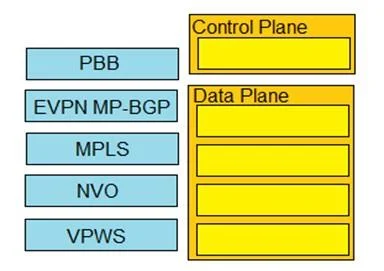
Drag and Drop Question Drag and drop the EVPN components from the left onto the correct planes on the right. Answer:
The correct answer is EVPN MP-BGP; PBB; MPLS; NVO; VPWS. EVPN Components and Their Planes EVPN (Ethernet VPN) separates control plane functions (how MAC/IP reachability is distributed) from data plane functions (how frames are actually forwarded). Each item maps to one of these planes. --- 1. EVPN MP-BGP → Control Plane MP-BGP…
Question
Drag and Drop Question Drag and drop the EVPN components from the left onto the correct planes on the right. Answer:
Exhibit
Answer Area
Drag items
Correct arrangement
- EVPN MP-BGP
- PBB
- MPLS
- NVO
- VPWS
Explanation
EVPN Components and Their Planes
EVPN (Ethernet VPN) separates control plane functions (how MAC/IP reachability is distributed) from data plane functions (how frames are actually forwarded). Each item maps to one of these planes.
1. EVPN MP-BGP → Control Plane
MP-BGP (Multiprotocol BGP, AFI 25 / SAFI 70) is the only control plane component in the list. It advertises EVPN route types (MAC/IP reachability, Ethernet Segment, Inclusive Multicast, etc.) between PE routers. Without it, none of the data plane technologies know where to forward traffic.
Common mistake: Thinking BGP is "optional" or can be replaced by flood-and-learn. In EVPN, MP-BGP is mandatory and definitional.
2. PBB → Data Plane
Provider Backbone Bridging (IEEE 802.1ah, "MAC-in-MAC") is a data plane encapsulation used in PBB-EVPN (RFC 7623). The outer B-MAC header carries traffic across the provider network. It's common in carrier/metro Ethernet environments.
Common mistake: Confusing PBB with PBBN (backbone networks) generically. PBB here specifically means the MAC-in-MAC encapsulation that EVPN can ride over.
3. MPLS → Data Plane
MPLS label-switched paths are the original EVPN data plane (RFC 7432). Labels are assigned per-MAC or per-ESI, and frames are forwarded using the MPLS forwarding table. This is the classic service-provider deployment model.
Common mistake: Assuming EVPN requires MPLS. MPLS is just one data plane option; EVPN is data plane-agnostic.
4. NVO → Data Plane
Network Virtualization Overlay (VXLAN, NVGRE, GENEVE) is the dominant data plane in data center EVPN deployments. EVPN-VXLAN (RFC 8365) uses NVO tunnels between VTEPs with MP-BGP providing the control plane. NVO decouples the underlay IP fabric from the overlay.
Common mistake: Treating NVO and MPLS as mutually exclusive. Enterprises use NVO; service providers typically use MPLS. The EVPN control plane (MP-BGP) is identical in both.
5. VPWS → Data Plane / Service Layer
Virtual Private Wire Service is a point-to-point Ethernet service (E-Line) built on EVPN (RFC 8214). It uses EVPN signaling but provides a single-point-to-single-point pseudowire, unlike EVPN's default multi-point (E-LAN) behavior. It sits at the data/service plane because it defines the forwarding behavior, not the control signaling.
Common mistake: Confusing VPWS with VPLS (multipoint). VPWS = E-Line (2 endpoints); VPLS/EVPN = E-LAN (multipoint). VPWS is also sometimes called EVPN Flexible Cross-Connect.
Summary Table
| Component | Plane | Role |
|---|---|---|
| EVPN MP-BGP | Control | MAC/IP route distribution |
| PBB | Data | MAC-in-MAC encapsulation (carrier) |
| MPLS | Data | Label-switched forwarding (SP) |
| NVO | Data | Overlay tunneling (DC/cloud) |
| VPWS | Data/Service | Point-to-point Ethernet service |
The key insight: one control plane (MP-BGP), multiple interchangeable data planes - that flexibility is EVPN's core design principle.
Topics
Community Discussion
No community discussion yet for this question.