
300-515 · Question #24
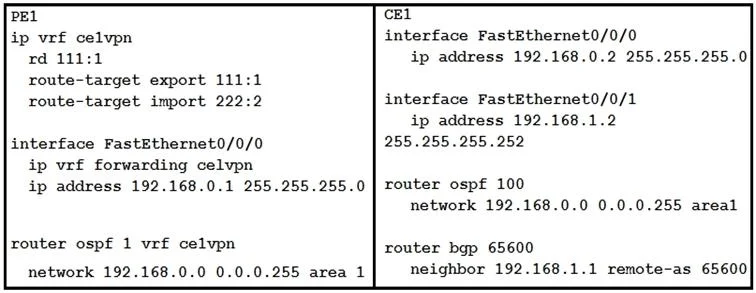
Refer to the exhibit. If the two devices are operating normally, which two conclusions can you draw from this configuration? (Choose two.)
The correct answer is A. CE1 must use OSPF to establish a neighbor relationship with PE1. D. The PE-CE routes between the devices are being exchanged by OSPF. Options A and D are correct because they describe the same observable fact from two angles: the exhibit shows OSPF configured as the PE-CE routing protocol, which means CE1 must use OSPF to form a neighbor relationship with PE1 (A), and those routes are therefore being…
Question
Refer to the exhibit. If the two devices are operating normally, which two conclusions can you draw from this configuration? (Choose two.)
Exhibit
Options
- ACE1 must use OSPF to establish a neighbor relationship with PE1.
- BPE1 labels the routes it learns from CE1 with the route-target 222:2 and shares them with its
- CPE1 labels the routes it learns from CE1 with the route-target 111:1 and shares them with its
- DThe PE-CE routes between the devices are being exchanged by OSPF
- ECE1 is supporting CSC.
How the community answered
(43 responses)- A79% (34)
- B7% (3)
- C12% (5)
- E2% (1)
Explanation
Options A and D are correct because they describe the same observable fact from two angles: the exhibit shows OSPF configured as the PE-CE routing protocol, which means CE1 must use OSPF to form a neighbor relationship with PE1 (A), and those routes are therefore being exchanged via OSPF (D).
Why the distractors fail:
- B and C both misidentify which route-target PE1 stamps on CE1-learned routes. In MPLS L3VPN, PE1 uses the VRF's export route-target to tag routes before advertising them via MP-BGP; only one of the two values shown can be the export RT, and the exhibit makes the other the import RT - so whichever value each option names, one must be wrong, and the phrasing (cut off at "shares them with its") also hints at an incomplete/misleading claim.
- E is wrong because CSC (Carrier Supporting Carrier) requires the CE to run MPLS/LDP and act as a mini-PE itself - a plain OSPF PE-CE adjacency is standard L3VPN, not CSC.
Memory tip: Pair A and D together as "same truth, two lenses" - the protocol (D = OSPF carries the routes) locks in the requirement (A = CE must speak OSPF). If you confirm one, the other is automatically correct.
Topics
Community Discussion
No community discussion yet for this question.