
300-515 · Question #23
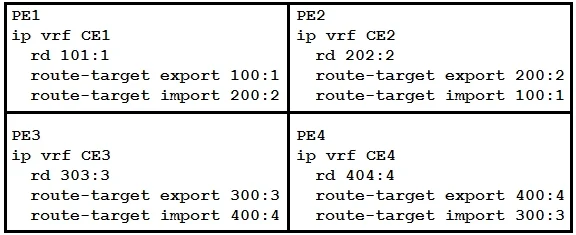
Refer to the exhibit. A network engineer has been called to configure the four PE devices in order to enable full communication among the four CE devices connected to them. While starting to…
The correct answer is A. Configure PE3 to export route-targets 100:1 and 200:2. B. Configure PE3 to import route-targets 100:1 and 200:2. In MPLS L3VPN, route-targets (RTs) control VPN route distribution: export RTs tag routes leaving a VRF into MP-BGP, and import RTs filter which routes are accepted into a VRF. PE3 is the source of the connectivity issue - it is missing both configurations, meaning its CE's…
Question
Refer to the exhibit. A network engineer has been called to configure the four PE devices in order to enable full communication among the four CE devices connected to them. While starting to configure, he experienced a connectivity issue. Which two tasks should the engineer perform in order to begin the process correctly? (Choose two.)
Exhibit
Options
- AConfigure PE3 to export route-targets 100:1 and 200:2.
- BConfigure PE3 to import route-targets 100:1 and 200:2.
- CConfigure PE4 to import route-targets 101:1 and 202:2.
- DConfigure PE2 to export route-targets 300:3 and 400:4.
- EConfigure PE1 to import route-targets 300:3 and 400:4.
How the community answered
(49 responses)- A78% (38)
- C14% (7)
- D6% (3)
- E2% (1)
Explanation
In MPLS L3VPN, route-targets (RTs) control VPN route distribution: export RTs tag routes leaving a VRF into MP-BGP, and import RTs filter which routes are accepted into a VRF. PE3 is the source of the connectivity issue - it is missing both configurations, meaning its CE's routes are never advertised to other PEs (no export), and it never receives routes from other PEs (no import), making it completely isolated. Options A and B together restore PE3's ability to both share and receive routes using the correct RT values (100:1 and 200:2) that match the rest of the topology.
Why the distractors are wrong:
- C uses fabricated RT values (101:1 and 202:2) that don't match the topology - importing non-existent RTs accomplishes nothing.
- D targets PE2 with RTs (300:3 and 400:4) that don't belong to PE2's VRF exports in this design.
- E targets PE1 to import 300:3 and 400:4 - those RTs aren't being exported by any relevant peer in the current broken state, so importing them on PE1 fixes nothing.
Memory tip: Think of RTs like a postal system - export RT is the label you stamp on outgoing mail, import RT is the label your mailbox accepts. A PE missing both is like an office with no outbox and a locked mailbox: fix both to restore communication.
Topics
Community Discussion
No community discussion yet for this question.